Loading image...
 © @scenicrimguide @thetamborine
 Most high end fireplaces tell a polished story about design. Few are honest about emissions. When you ask what that statement piece will do to your renovation’s carbon footprint, the answers often thin out.
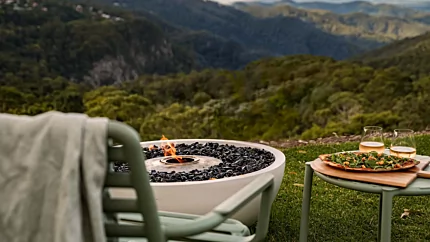
Bioethanol designer fireplaces give you a different brief. The fuel runs in a closed carbon cycle, combustion is clean, and the fireplace itself is built from materials selected to last, not to be replaced. No chimney, no gas line, no heavy structural work.
Loading image...
© @scenicrimguide @thetamborine Loading image...

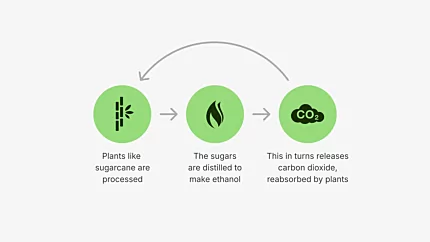
A bioethanol fireplace is eco-friendly because it burns a renewable plant-derived fuel inside a closed carbon cycle, releases only water vapour and CO2 during combustion, and requires no flue, chimney, or gas connection. Four pillars sit underneath that single sentence, and they are worth pulling apart.
Renewable plant-sourced fuel. Bioethanol is distilled from sugarcane, grain, or waste biomass through fermentation. According to IEA Bioenergy Task 39, sugarcane-derived bioethanol achieves 70 to 80 percent greenhouse-gas savings compared with gasoline.
Closed-loop carbon. The CO2 released when bioethanol burns is the same CO2 the source crop absorbed while growing. Researchers writing in Current Biology describe bioethanol as a fuel that allows, in principle, for carbon to be run in a closed cycle.
Clean combustion output. No smoke, no soot, no ash, no particulates. The National Energy Foundation confirms bioethanol burns "producing only carbon dioxide and water vapor as byproducts."
No infrastructure required. No flue, no chimney, no gas line means no steel chimney system, no roof penetration, and no embodied carbon from heavy structural work.
The fuel question is the easy half. The harder half, the one almost no luxury fireplace brand will sit still long enough to answer, is what the fireplace itself is made of and how long it is built to remain useful. A "green" product that needs replacing in five years is not green at all. A piece made to last thirty years has a fundamentally lower lifetime footprint, even if that word never appears in the marketing copy.
Four material credentials run through the EcoSmart Fire designer fireplaces range and underwrite the longevity argument:
Grade 304 stainless steel construction across firebox, burner, and structural components, chosen for corrosion resistance, dimensional stability, and recyclability. The Specialty Steel Industry of North America reports Grade 304 delivering up to 80 years of service in architectural use, with 100 percent recyclability and a 92 percent end-of-life recapture rate.
Borosilicate glass fire screens, the same family of glass used in laboratory equipment, precision-manufactured to handle direct thermal load for decades.
A natural-material palette on the Pillar collection: Italian Carrara marble, Turkish Nero Portoro marble, real oak veneer, and brushed brass. These are materials with provenance and patina, the kind that improve with age rather than dating.
Powder-coat finishing on Pop and selected models, a dry process that emits effectively zero volatile organic compounds compared with solvent-based paint and produces a far more durable surface.
A brief aside on the marble point: stone selection in fireplace design is rarely just decorative. Carrara has been quarried in Tuscany since Roman times, and the same blocks were used in the Pantheon and Michelangelo's David, which is to say it has already proven its longevity over a couple of millennia. That is the kind of evidence base we lean on when we call a material sustainable.
Longevity is sustainability. The greenest fireplace is the one you never have to replace.
Bioethanol designer fireplaces require no flue, chimney, or gas line. That single fact removes the most environmentally costly chapter of a traditional fireplace install: the structural work. No roof penetration. No 6-metre run of insulated steel chimney. No gas piping. No on-site cutting, sealing, or weather-proofing. The embedded carbon of a fireplace project drops sharply when none of that exists.
"Ventless" does not mean "zero ventilation," though, and the brands that gloss over that distinction are the same ones that struggle to answer technical questions later. A bioethanol fire still needs a room large enough for the air it consumes during combustion. EcoSmart Fire publishes minimum room volumes against burner output, and the figures are unambiguous.
Burner | Heat output | Heating area | Minimum room volume |
|---|---|---|---|
AB3 | 2 kW (6,824 BTU/hr) | 20 m² | 40 m³ |
BK5 | 4 kW (13,650 BTU/hr) | 35 m² | 70 m³ |
AB8 | 6 kW (20,470 BTU/hr) | 60 m² | 116 m³ |
That kind of specificity matters most in the projects where conventional fireplaces simply cannot go: apartment renovations, heritage homes where flue work is restricted, top-floor units with no roof access, and rental properties where structural modification is off the table. The dual-rated indoor and outdoor models in the range, the T-Lite 3 and the Pop collection, compound that placement freedom by moving between courtyards, balconies, and living rooms without rework.
Loading image...
Concept is one thing. Named pieces with real specifications are another. Four fireplaces in the bioethanol designer collection each carry a different facet of the eco-luxury argument, and together they cover most of the room shapes a homeowner is likely to encounter.
Orbit is the rotating, elevated centrepiece of the range, designed as a sculptural anchor for an open-plan room. Our own product copy describes it as "a sustainable fire," and the description earns itself: long-lasting, low-impact materials, AB8 burner output, the sort of presence that means it doubles as object rather than appliance.
Where the material story lands hardest is in the Pillar collection. The Pillar 3T and Pillar 3L sit on a compact 412 mm square footprint and finish in Italian Carrara marble, Turkish Nero Portoro marble, real oak veneer, or brushed brass. Each finish is a serious natural material chosen for how it ages.
Ghost is the see-through, double-sided fire that suits room dividers, freestanding kitchen islands, and any layout where two zones share a flame. It runs on the same e-NRG fuel as the rest of the range, and the sustainability credentials carry through with it.
Pop is the playful, colour-finished, powder-coated unit that signs into both indoor and outdoor environments. It is the entry point into the eco-luxury collection, and the powder coat is the sustainability detail most people miss: a finish that lasts longer and produces less environmental cost than a sprayed paint job ever does.
The range extends beyond these four. The Igloo (a BK5-burner outdoor centrepiece) and Be (a slim, dual-sided wall application) round out the collection for the projects whose geometry asks for something different.
Every designer fireplace in the EcoSmart Fire range carries three certifications by name: UL 1370 (USA, O-TL Listed), EN 16647 BSI (Europe and the United Kingdom), and the ACCC Safety Mandate (Australia). UL Standards & Engagement describes UL 1370 as the standard that "sets testing and manufacturing requirements that can be verified by independent, nationally recognized testing laboratories." Sustainability without safety is greenwashing; the certifications are how we prove the claim is honest.
The eco-luxury promise has to survive contact with daily life. Refuelling is unceremonious. A full tank of e-NRG burns for 8 to 11 hours in an AB3 model, 7 to 11 hours in a BK5, and 7 to 9 hours in an AB8, so the model you choose matches the night you have in mind. You pour the fuel in, ignite, and that is the maintenance ritual for the night.
Day-to-day care is light. There is no soot, no ash, and no chimney to sweep. Stainless surfaces clean with a damp cloth, glass screens wipe down between burns, and the burner units themselves are dishwasher-safe on most models. Compared with the seasonal commitment a wood fire demands, the time-cost difference is significant.
The fuel itself is non-toxic and household-safe, which only becomes apparent when something goes wrong. If you spill, you wipe it up. If you finish a season with fuel still in the tank, you can dilute it with water and pour it down a domestic drain. Try that with kerosene or natural gas and you would be calling a hazmat contractor.
Three variables decide most projects: how big the room is, where the fireplace needs to sit, and which material language fits the rest of the interior. The decision falls out naturally once you have those three.
Room size | Suggested burner | Model family | Placement |
|---|---|---|---|
Under 35 m² | AB3 (2 kW / 6,824 BTU/hr) | Pillar | Wall, table-top, freestanding |
35 to 60 m² | BK5 (4 kW / 13,650 BTU/hr) | Igloo, Pop 3L | Indoor-outdoor, freestanding |
60 m² and above | AB8 (6 kW / 20,470 BTU/hr) | Orbit, Ghost configurations | Sculptural centrepiece |
The material choice is where personal taste does the rest of the work. Marble for the rooms that already hold their breath when you walk in. Oak veneer where the rest of the joinery is timber. Brushed brass where the lighting and hardware are already warm. Powder-coat colour where the room asks for accent.
Choosing a bioethanol designer fireplace is not an environmental compromise on luxury. It is the route that delivers both, and the full designer fireplace collection is where the homeowners who already know what they want can map shortlist to specification.