Blog

  /  

Fireplace Lighting Design: Using Ambient and Accent Lighting to Elevate Your Designer Fireplace

Fireplace Lighting Design: Using Ambient and Accent Lighting to Elevate Your Designer Fireplace

A fireplace that has been chosen with care and then dropped into a room lit by a single ceiling pendant is a quiet kind of waste. The flame is doing everything it can, the surround is doing everything it can, and the lighting around them is flattening both. The room reads as well-lit rather than considered, and the fireplace becomes a feature in the floor plan rather than the thing the eye returns to.

Fireplace lighting design is the discipline that fixes that gap. It treats the flame as a lighting element in its own right, decides how the rest of the room should behave around it, and resolves the layered scheme before anyone reaches for a fixture. The choice of fireplace and the choice of lighting belong to the same brief, not to two trades who meet at handover. EcoSmart Fire has spent two decades designing fireplaces for exactly this kind of brief, appliances where the material, the form, and the flame are already part of the lighting composition.

Published:
· Updated:

Loading image...

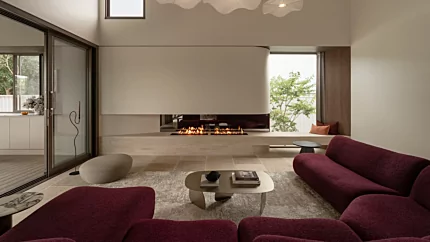
thumbnail: webimage-XL900-Ethanol-BurnerXL900 Ethanol Burner © Comma Projects and Alyne Media

Why fireplace lighting design deserves its own brief

There is a useful distinction between a fireplace that sits in a room and a fireplace that anchors one. A fireplace anchors a room when the surrounding lighting, materials, and sightlines all defer to it. Without that deference, the surround sinks into the wall, the flame competes with downlights overhead, and the eye has nowhere obvious to settle.

The most common cause is generic ambient lighting set too bright and too cool. A ceiling array that lights the room evenly is doing its job, technically. It is also washing the flame out and erasing the texture from the surround that the architect specified for exactly this moment. Lighting the room evenly is not the same as lighting it well.

Treating lighting design and fireplace selection as one brief avoids that outcome. The fireplace becomes the focal point you build the lighting around, not the object you light from above as an afterthought. That logic applies whether the project is a single living room or a full open-plan layout with several zones competing for attention, and it shapes everything that follows in our designer fireplaces collection.
The three layers of fireplace lighting design

Fireplace lighting design works in three layers. Ambient lighting sets the room's base mood, accent lighting frames the fireplace as a focal point, and task lighting supports activity in the surrounding zone. Remove any one layer and the composition collapses: pure ambient flattens the fire, pure accent leaves the room feeling staged, pure task light makes the space feel like a study.

The layered framework is the established professional model for residential interiors, as Laura Gaskill set out in Houzz's lighting plan primer. It is also the framework that shapes the briefing conversation when architects and interior designers work with the EcoSmart Fire design team. What follows applies that model to a fireplace context, where one of the layers, the flame itself, is non-negotiable.

Ambient lighting - setting the room's base mood

Ambient lighting establishes the overall light level the flame reads against. A bioethanol or gel fire is luminous, but its luminance is finite. Push the surrounding room beyond a certain brightness and the flame stops carrying the space, even though it is still burning at full strength. The fire has not changed; the contrast against the wall behind it has.

The fix is to think of ambient lighting as a dimmable base layer rather than a fixed setting. Daytime ambient can sit higher to balance daylight coming through windows. Evening ambient should drop to a level where the flame becomes the brightest single object the eye can see. That is when the fireplace starts doing its real job, lifting the rest of the room rather than competing with it.

Accent lighting - framing the fireplace as a focal point

Accent lighting frames the architecture around the flame, not the flame itself. The fire is its own light source; pointing a spotlight at it tends to dilute its character rather than amplify it. What accent lighting can do is reveal the surround, the hearth, the wall plane behind the fireplace, and the sculptural form of the appliance itself.

Three placement principles do most of the work:

  • An overhead downlight set forward of the surround grazes the front face and lifts shadow detail.

  • An uplight from below picks up the underside of a mantel or a freestanding form, making the appliance feel like it is floating.

  • A raking light, mounted close to the wall and angled across the surface, exposes the texture in stone, plaster, or timber that would otherwise sit flat.

The shared principle is simple. Light the architecture, not the fire. The fire takes care of itself.

Task lighting - supporting the surrounding zone

Task lighting belongs to the activity around the fireplace, not the fireplace itself. Reading nooks, a console where someone pours a drink, art on the adjacent wall, all of these can carry their own light without disrupting the composition. The trick is making them switchable and dimmable independently, so the room can move from “we are still cooking” to “the fire is now the brightest thing in the room” without anyone having to fuss with a panel.

When the evening reaches that second mode, most task lighting should be off or near it. The reading lamp by the armchair stays on if someone is reading. Everything else goes dark and lets the fire do the work.

Matching colour temperature to flame warmth

Lighting near a fireplace should sit in the warm-white range, generally around 2,700 to 3,000 Kelvin, so the surrounding fixtures read as continuous with the flame rather than competing with it. Cool-white lighting above about 4,000 Kelvin makes the fire look orange in an unflattering way and signals “office” rather than “evening”.

A real flame sits much warmer than any electric fixture you can buy. NIST research by Hamins, Bundy and Dillon measured the soot region of a candle flame at roughly 1,400 to 1,700 Kelvin, and a physics resource published by Leibniz University Hannover places the brightest visible portion of a candle flame at approximately 2,000 Kelvin. Bioethanol flames behave visually in the same family. That puts the flame deep in the amber range, well below the warm-white settings most homes use for ambient lighting.

Fixture colour temperature

Visual character

Relationship to flame

2,000 K

Candlelight, deep amber

Closest to the flame itself

2,700 K

Warm incandescent

Reads as continuous with the flame

3,000 K

Warm white

The DOE Building America recommendation for residential settings

4,000 K

Neutral white

Pulls the eye away from the flame

5,000 K and above

Cool white

Fights the flame; reserve for utility spaces

The DOE Building America report on residential lighting recommends 3,000 K and a CRI of 80 or higher as the residential baseline. The WELL Building Standard sets the bar higher again, asking for Ra of 80 and R9 of 50 in occupiable spaces. R9 specifically measures how accurately the light renders deep reds, which affects how skin tones and warm materials read in the room. CRI matters because warm-white light at low CRI flattens skin tones and surface colour, which undoes the visual richness a fireplace is meant to bring into the room.

If the project allows for it, fixtures with dim-to-warm behaviour are worth specifying near the fireplace. They shift their colour temperature downward as they dim, so the lighting tracks the flame on its way into the evening rather than staying at a single fixed point. CIBSE’s lighting CPD work notes that warmer light around 3,000 K supports rest and relaxation, which is most of what a living room is asked to do once the fire is lit.

How accent lighting interacts with fireplace materials and surrounds

Accent lighting reads differently depending on what it is hitting. The same fixture that lifts a marble vein into beautiful relief can throw an ugly hot spot onto polished metal or wash out the grain of a timber surround. EcoSmart Fire’s Designer Fireplaces range draws on eight distinct material families, each one selected for how it reads in a room as well as how it holds up over time. Knowing which material is in your appliance changes the accent brief. Those families run from brushed and ceramic-coated stainless steel through powder-coat finishes, Carrara and Nero Portoro marble, real oak veneer, borosilicate glass, and Fluid Concrete. Each one rewards a slightly different lighting approach.

A few useful groupings:

  • Stone surfaces, including marble and concrete: raking light at a low angle picks up veining and aggregate texture. White Carrara lifts dramatically under grazing light; striated black Nero Portoro takes a softer hand because the dark base can swallow brighter spots. Fluid Concrete shows aggregate well under raking light and feels best with matte, lower-intensity sources.

  • Brushed metal and ceramic-coated stainless: directional light produces strong highlight and shadow contrast on a brushed finish, while a ceramic-coated black absorbs light and shows form rather than surface. Avoid head-on spots that flatten the brushwork into a mirror.

  • Powder-coated colour, including the brighter Pop tones: matte finishes carry low specular reflection, so accent light reads as colour saturation rather than highlight. The aim is to lift the colour without bleaching it.

  • Timber veneer: low-angle raking light deepens the grain shadow and is generally more flattering than a downlight that lands flat on the face.

  • Borosilicate glass: when the glass is acting as a lamp-shade form, the flame itself becomes the source. External accent light should sit well off-axis so it does not catch the glass and create a reflection that competes with the flame.

A freestanding sculptural appliance behaves differently from a recessed model. A piece set into the wall asks for accent light that lifts the surround and the wall plane that frames it. A freestanding form needs light that reads the object in the round, often with one main raking source and one softer fill from the opposite side so the silhouette does not collapse. Many of the freestanding designer fireplaces in our range are deliberately sculptural for this reason, and the lighting brief is the moment that pays the sculpture off.

Designing lighting hierarchy for open-plan living

Loading image...

thumbnail: webimage-Pillar-3T-Designer-FireplaceEcoSmart Fire Pillar 3T Designer Fireplace showcases a freestanding bioethanol column in an indoor private residence living area.

Open-plan living rooms have a focal-point problem that single-room layouts do not. A kitchen island wants attention. A dining pendant wants attention. An art wall, a stairwell, a media zone, all of these want attention. Drop a fireplace into that mix without a lighting hierarchy and the room reads as four small rooms pretending to be one.

Houzz’s coverage of open-plan focal points puts it simply: every functional zone should have its own focal point, but one of them needs to be dominant. In rooms that include a fireplace, the fire is almost always the right candidate. It is the warmest light, the most movement, and the only object in the room that genuinely changes by the minute.

The lighting hierarchy that supports that decision usually looks like this:

  1. The fireplace circuit (ambient at low setting plus accent lighting on the surround) becomes the room’s centre of gravity in the evening scene.

  2. The kitchen and dining circuits drop back. Under-cabinet light goes off. The dining pendant dims or goes off entirely once the meal is over.

  3. Task lighting in other zones holds at the level the activity actually needs, no higher.

The point is not to dim the rest of the room into uselessness. It is to let the fireplace win the contest for attention without anyone having to be told that is what it is doing. Sightlines and approach views matter here too. The lighting at the threshold someone uses to enter the room should already cue them toward the fireplace, with the brightest single object in their field of view being the fire itself. That sequencing logic applies across most of the layouts you can build from our open-plan designer fireplaces.

Lighting an outdoor designer fireplace or alfresco zone

Outdoor lighting briefs invert most of the indoor logic. There is no ambient ceiling layer to dim, the night sky is the base level, and the fireplace is competing with darkness rather than with the walls. The result is that outdoor accent lighting is doing more work and ambient lighting is doing less.

The supporting cast outdoors is landscape lighting: path lights, planting uplights, low-level fixtures washing seating zones. Houzz’s outdoor lighting guidance recommends a luminous wash as the base layer, with individual elements spotlit on top of it, and a strong preference for warm yellow-to-amber LED rather than cool white. For alfresco entertaining, 2,500 to 3,000 Kelvin is the cosy range, the same range that works around an indoor fire.

Three outdoor-specific conditions change the fixture brief. Fixtures need to be IP-rated for the conditions they sit in: the IEC 60529 IP rating system defines IP44 as splash-proof, IP65 as dust-tight and jet-proof, and IP67 as suitable for temporary immersion, and the right rating depends on whether the fixture is sheltered, exposed, or in a wet zone. Glare matters more outdoors than indoors because there is no ceiling to bounce light off, so a misaimed spotlight stays misaimed all evening. And the fireplace itself becomes the dominant visual anchor in the garden, which means surrounding fixtures should be treated as supporting players, not co-stars.

EcoSmart Fire’s outdoor-rated models are specified to handle weather on their own; the lighting brief is about settling them into a wider garden scheme.

Smart lighting and scene programming around a fireplace

Smart lighting is at its best when nobody in the room has to think about it. The brief is to write the scenes once, hide the controls, and let the room move through the evening as if the lighting were following an instinct. Around a fireplace, that pays off more than almost anywhere else in the house, because the fire’s behaviour changes during the evening and the surrounding lighting should change with it.

A handful of scenes earn their keep. Pre-dinner sits with ambient at roughly half, accent on the fireplace surround at full, and task lighting in the kitchen at full while the meal is in motion. As the household moves to the table, ambient drops further, the dining pendant takes over, and the fireplace accent stays on. After dinner, ambient pulls down to a low setting, kitchen and dining go off, the fireplace accent remains, and the reading lamp by the armchair stays on if anyone is reading. By the last call, everything is off except the fireplace surround accent at a low setting, so the flame is the brightest object in the room.

Dimming curves matter too. A linear dimmer can feel jarring at low levels because the perceived change in brightness accelerates as the lamp approaches off. A logarithmic curve, or a fixture with built-in compensation, feels much smoother to the eye. Scene memory and time-of-day automation are the last layer, so the same panel button delivers a different setting at six in the evening than it does at ten.

Scene programming through whole-home control platforms is now expected practice in high-end residential projects, with the lighting designer writing the scenes alongside the architect rather than after fit-out. The brief is not the technology; it is the experience. The technology should disappear into the wall. EcoSmart Fire’s Designer Fireplaces are designed to integrate into these schemes, the bioethanol models carry no smart-home dependency, so they fit into any control architecture the project specifies.

Safety and fixture choice near a working flame

EcoSmart Fire’s clearance specifications are precise enough to brief a lighting designer in a single conversation. For fixtures mounted above or close to the flame, the relevant reference is the fixture’s rated heat tolerance, a figure the manufacturer’s data sheet will state, matched against the appliance’s published clearance envelope. Treating that match as a discrete question rather than rolling it into the general lighting plan keeps the brief tidy and the specifier confident.

Two reference points are useful here. IEC 60598-1 and IEC 60598-2-24 cover luminaire heat tolerance and maximum mounting-surface temperature for general and restricted-surface-temperature luminaires; both standards carry specific temperature thresholds that the fixture manufacturer’s data sheet will state. The exact figures are paywalled, but the citation by standard number is enough to brief a lighting designer or electrician.

For anything mounted directly above the fireplace, including a TV or a luminaire, the cluster supports three approved approaches:

  1. A non-combustible mantel or ledge sitting between the flame and the fixture, acting as a heat shield.

  2. A recessed niche set at least 300 mm above the fireplace opening.

  3. A set-back mounting position at least 300 mm above the flame opening, so the fixture sits clear of the convection plume. Anything closer is a specifier sign-off question, matched against the fixture’s heat tolerance.

Indoors, the cluster guidance is a minimum 600 mm [23.6 in] side clearance to stable furniture and 1,500 mm [59.1 in] overhead clearance; outdoors the overhead clearance lifts to 2,000 mm [78.7 in]. Lighting fixture placement should respect those envelopes as a starting point. The combination of correct fixture rating and correct mounting clearance is what makes this category of installation comfortable to live with.

This is the moment the lighting brief and the designer fireplaces installation guide genuinely interlock. Treat the two as one decision, not two.

Specifying lighting at the design stage, not as an afterthought

Almost every lighting outcome described above is much easier to deliver at the design stage and much harder to retrofit. Circuits get planned, dimmers get located, fixture cut-ins get coordinated with the joinery, and the fireplace’s exact position is fixed before the wall closes up. Trying to add a wall-grazing detail or a niche light after the plaster has set is a different and more expensive project.

The lighting designer is one of the most useful trades to introduce early in a residential project, and consistently one of the most often introduced late. High-end practices now bring lighting in alongside the architect rather than at fit-out, and the difference shows in how the rooms read at night. Treat the fireplace brief as one of the moments to do the same.

Practical questions to ask early:

  • Where will the fireplace sit, and which walls and surfaces will accent lighting need to reach?

  • How many separate circuits should the room have, and where will the dimmer panel live?

  • What colour temperature is being specified across the fixtures in the room, and is dim-to-warm worth the cost premium near the fireplace?

  • Is the room intended to host scene programming, and if so, who is writing the scenes?

  • For ceiling-mounted fixtures sitting above the fireplace, what is the manufacturer’s stated heat tolerance, and does the mounting clearance match it?

Homeowners and architects use the same questions; the only thing that changes is who answers them. The earlier the brief gets onto paper, the more the finished room rewards the work that went into the bespoke fireplace design the project began with.

Loading image...

© Comma Projects and Alyne Media

A short close - letting the fire do the work

Good fireplace lighting design is the lighting nobody notices. The flame carries the room, the surround reads the way the architect specified it, and the rest of the lighting recedes into the role of supporting cast. Nothing in the scheme draws attention to itself, because attention is going where it should: to the fire.

The layered framework is the way in. Ambient sets the level. Accent frames the architecture. Task supports the activity around it. Colour temperature stays warm. Fixture choice respects the heat. Scenes do the thinking so the room can change quietly through the evening.

The fireplace was the thing that anchored the brief. The lighting is the thing that lets it anchor the room.

References

Related Articles

Designer Fireplaces

Designer Fireplace Installation Guide: Placement, Safety and Space Planning

Safety
Placement, safety clearances, and space planning for designer fireplaces.

How to Choose the Right Designer Fireplace: A Complete Buyer's Guide

Buying Guides
A complete guide to choosing the right designer fireplace for any space.

Sustainable Luxury: Why Bioethanol Designer Fireplaces Are the Eco-Friendly Choice

Sustainability
Why bioethanol designer fireplaces are the most eco-friendly luxury choice.

Bespoke Fireplace Design: Working with Architects and Interior Designers

Design Trends
How architects and specifiers design bespoke bioethanol fireplaces with EcoSmart Fire.

Small Space Solutions: Compact Designer Fireplaces for Modern Living

Design Trends
How ventless designer fireplaces redefine luxury interiors as statement pieces.

Ventless Fireplaces Explained: How They Work and Why They're Changing Interiors

Technology
How bioethanol ventless fireplaces work and why they're transforming interiors.

Designer Fireplaces for Open-Plan Living: Creating Warmth Without Walls

Design Trends
How designer fireplaces create focal points in open-plan homes.

Designer Freestanding Fireplaces as Architectural Sculptures: Statement Installations

Design Trends
Five sculptural archetypes for designer freestanding bioethanol fireplaces.

Freestanding Fire Furniture: Bringing Warmth Anywhere in Your Home

Buying Guides
Imagine the freedom to create an intimate gathering space wherever inspiration strikes - whether it's transforming your living room for an evening soirée, adding warmth to your study during the winter months