Loading image...

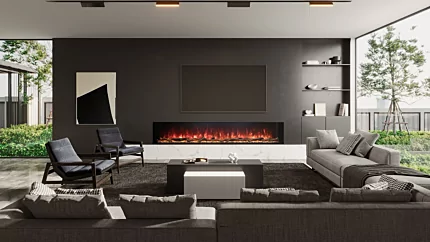
Switch 96SS Electric Fireplace
A TV above an electric fireplace should not feel like a compromise. Done well, it reads as a considered feature where flame, screen, and architecture all work together. The hesitation usually starts with heat, borrowed from experience with wood and gas, even though electric behaves very differently.
Our Switch and Motion fireplaces use projected LED flame effects and a separate forward-facing heater that you choose to activate or leave off. In flame-only mode they run cool, and even on full heat a 300 millimetre clearance above the opening keeps the TV safely out of the warm air stream. That simple rule is the technical foundation for every layout in this guide.
Loading image...
Switch 96SS Electric Fireplace
Our electric units can run in flame-only mode at 30 to 106 W with zero heat output, which removes the heat-damage risk to any TV mounted above them. That’s the answer most articles dance around. It’s also the reason TV above fireplace layouts that would be reckless with a wood-burner or a gas insert are entirely workable here.
Combustion fireplaces, whether they burn timber, gas, or bioethanol, push genuine radiant and convective heat upward. A flue or hood concentrates that thermal plume, and anything in its path eventually pays the price. LED-based electric fireplaces have no combustion chamber, no flue, and no upward plume. The flame is light, projected through carefully engineered optics, and the heat element is a separate forward-facing fan that you choose to switch on or leave off.
When the heater is off, our Switch range draws 42 W at the smallest unit and tops out around 106 W on the largest, while the Motion range sits between 30 W and 85 W. That’s roughly the power profile of a few LED bulbs. The face of the unit stays close to ambient room temperature, and there is no upward thermal column to worry the panel above.
That said, this isn’t a free pass. With the heater engaged on full output, both ranges deliver up to 3,000 W (10,200 BTU/hr) of warmth into the room, and the front face of the unit does get warm. The 300 mm clearance rule below isn’t a relic of combustion engineering; it’s a sensible buffer for the heated mode and for the lifetime of the electric fireplaces collection you’ve spent good money on. Plan the wall as if you’ll occasionally run the heat, and the screen above will be safe whether you do or not.
Mount the TV so its centre sits between 1,067 and 1,219 mm (42 to 48 in) from the floor, with a minimum of 300 mm (12 in) clearance above the top of the fireplace opening. That single specification answers the most common search query and gives you a starting point you can mark on the wall before any cabling goes near it.
The numbers shift depending on which range you choose. Our Switch series stands 632 mm (24.9 in) tall, while the Motion series is slightly slimmer at 607 mm (23.9 in). Those two heights, plus the 300 mm clearance, plus the height of the TV itself, are the only figures you need to lay out the wall on paper.
There are three approaches that work reliably. The first is a non-combustible mantel or ledge above the fireplace opening, which acts as a heat shield and a visual break between the flame and the screen. The second is a recessed niche, with the TV set 300 mm above the opening inside a plaster or stone reveal. The third is a flush wall with the TV set back off the flame plane, again 300 mm above the opening. All three give the screen its own visual real estate rather than letting it sit awkwardly close to the fire.
Ergonomics is the harder problem, and it’s worth being honest about. SMPTE recommends a centre-screen height roughly level with the seated viewer’s eye line, which is usually somewhere between 1,067 and 1,219 mm. Stack the fireplace, the clearance, and a 65 in TV, and that centre can drift well above the ideal. Two fixes work. A tilt mount angled 10 to 15° downward improves the viewing angle dramatically and brings the effective sight line back into range. The other option is to choose a slim wall-mounted unit lower on the wall, which gives the TV more room to breathe without climbing.
Element | Specification |
|---|---|
Minimum clearance above fireplace opening | 300 mm (12 in) |
Recommended TV centre height from floor | 1,067 to 1,219 mm (42 to 48 in) |
Switch unit height | 632 mm (24.9 in) |
Motion unit height | 607 mm (23.9 in) |
Tilt mount angle (when needed) | 10 to 15° downward |
A brief aside worth noting: prolonged neck flexion is genuinely a health issue, not just an aesthetic one. The team at ITS Hawaii, summarising the cervical loading research, notes that the effective load on the cervical spine more than doubles when the head tilts 15° forward. Stack a TV too high and you’re designing your guests into a stiff neck. Worth a tilt mount.
As a rule, the fireplace should be wider than the TV by at least 100 to 150 mm on each side. That margin keeps the screen from visually overpowering the flame and gives the composition a base that reads as anchored rather than precarious. It’s the single rule of thumb that separates a confident TV wall from one that looks like the TV swallowed the fireplace.
Our electric range spans from 30 in units suited to bedrooms and study nooks all the way up to three-metre installations made for double-height rooms and commercial lobbies. The pairing table below is the practical version of that range, expressed in TV sizes rather than millimetres.
Model | Unit width | Best TV size pairing |
|---|---|---|
Motion 30 | 762 mm / 30 in | 24 to 32 in TV |
Switch 44 / Motion 52 | 1,118 / 1,311 mm | 40 to 50 in TV |
Switch 56 / Motion 60 | 1,426 / 1,525 mm | 55 to 65 in TV |
Switch 68 / Motion 76 | 1,732 / 1,928 mm | 65 to 75 in TV |
Switch 80 | ~2,032 mm | 75 to 85 in TV |
Switch 96 / Motion 100 | 2,446 / 2,543 mm | 85 in TV or projector wall |
Switch 120 / Motion 120 | 3,050 / 3,157 mm | Projector or multi-display setup |
The right way to read this table is from the wall, not the catalogue. Measure the wall, decide where the TV centre needs to sit, pick the screen size that suits the room, then size the fireplace to comfortably exceed it. Choosing the fireplace first and then squeezing a screen on top of it is how people end up with a 75 in TV crowning a 44 in unit, which is the proportion equivalent of a small hat on a tall person.
There are four layouts that consistently work, and each suits a different room.
The stacked vertical layout puts the TV directly above the fireplace and is the most space-efficient option. It suits living rooms where one wall has to do everything, and it tends to be the default for apartments and townhouses where wall space is finite. Done well, it reads as a single composed feature. Done badly, the TV looks like an afterthought bolted to a focal point that wasn’t designed to host one.
Side-by-side layouts place the TV beside the fireplace rather than above it, usually with a continuous low cabinet running the length of the wall. Ergonomically, this is the easiest layout to live with, because the TV centre sits at proper viewing height without any tilt-mount gymnastics. It also gives the fire its own piece of wall rather than reducing it to a base for the screen.
A recessed niche above the fireplace is the most architectural option. The TV slots into a built-in niche framed in plaster, timber, or stone, with the fireplace below in its own reveal. Our Motion units help here because their 239 mm depth lets you detail a niche on a standard 90 mm stud wall with relative ease. Our Switch range, at 292 mm deep, pairs naturally with thicker stone surrounds and deeper plaster reveals where you want a more substantial frame. Either way, the fireplace sits within the architecture rather than on top of it.
The concealed or motorised approach removes the TV from the composition entirely when it’s not in use. A sliding panel, a piece of artwork on a track, or a motorised lift inside a cabinet all work. This is the layout that lets a room read as a living room when the screen is off and as a media room when it’s on. It costs more, takes more planning, and rewards both with the cleanest possible result.
A word on display tech. Frame-style TVs that display artwork at low brightness when idle have softened the design problem considerably over the past few years. If the screen can sit there looking like a picture rather than a black void, the case for elaborate concealment weakens. Pair one of those with a slim built-in electric unit and the wall reads as artful even when nothing is on.
Our Switch range is the only electric line we rate for outdoor installation under a covered patio. That single fact opens up an outdoor TV above fireplace layout that almost no editorial covers, and it’s becoming one of the more common briefs we see from architects designing alfresco lounges and hospitality terraces.
The conditions are non-negotiable. The unit must sit under a patio cover or fixed overhang, never directly exposed to wind-driven rain. The TV must be a properly outdoor-rated model, designed for the ambient temperature and humidity swings the location will see. Mounting hardware and cabling should be weather-rated and installed by someone who knows the local electrical code. Our Motion range stays indoor only; do not put it on a covered patio just because the patio is covered.
When all three conditions land, you get a use case the indoor world can’t match. A covered terrace with a fireplace and a screen turns into an outdoor living room you can use across most of the year, which is why hospitality clients keep specifying it. The outdoor fireplace options for terraces and alfresco lounges have grown into one of the most replicated layouts in recent commercial work.
No, provided you maintain a minimum 300 mm (12 in) clearance above the fireplace opening, or run the unit in flame-only mode where heat output is zero. Our Switch and Motion ranges direct warmth forward through a dedicated fan rather than venting it upward through a flue, which is the fundamental reason electric is a safer host for a TV wall than combustion.
Mount the TV so its centre is between 1,067 and 1,219 mm (42 to 48 in) from the floor, with the bottom edge sitting at least 300 mm above the fireplace opening. If stacking forces the centre higher than the seated eye line, a tilt mount angled 10 to 15° downward brings the viewing angle back into a comfortable range.
Yes. In flame-only mode our electric fireplaces draw 30 to 106 W depending on model, roughly the power profile of a few LED bulbs, and produce no heat. You can run both indefinitely with no thermal concern, and the optics are designed to give the flame the same visual presence whether or not the heater is engaged.
Yes. Electric units have no flue, no combustion, and no radiant thermal plume rising from the firebox. Gas and wood fireplaces concentrate hot exhaust gases upward through a flue or hood, which is the heat path that genuinely threatens a TV mounted above. Our electric range removes that path entirely.
Yes, with three conditions. The fireplace must be a Switch model rated for outdoor under-cover installation; the TV must be a genuine outdoor-rated unit, not an indoor TV repurposed; and the mounting and cabling must be weather-protected and code-compliant for the location. Our Motion range is indoor only and should not be used in an outdoor setting.
Loading image...
The reframe is the point. A TV above an electric fireplace isn’t a thermal problem dressed up as a design decision; it’s a design decision with a thermal footnote. Choose the flame-only mode when the heater isn’t needed, keep 300 mm of clearance above the opening for the times you do want warmth, and the rest of the brief reduces to proportion, height, and layout.
Three steps will get most rooms 90% of the way there. Measure the wall, then mark the seated eye line and work back to a TV centre height between 1,067 and 1,219 mm. Use the pairing table to size the fireplace 100 to 150 mm wider than the screen on each side. Choose the layout (stacked, side-by-side, recessed, or concealed) that suits the room, the budget, and the way the space is actually used.
When the brief lands on a covered patio, our Switch range opens up the outdoor version of the same wall. When the brief stays indoors, either range will work, and the choice between them tends to come down to wall depth, surround detail, and the visual character you want the flame to carry.