Blog

  /  

Electric Fireplace Flame Technology Explained: LED, 3D, Holographic & Motion Picture

Electric Fireplace Flame Technology Explained: LED, 3D, Holographic & Motion Picture

Choosing an electric fireplace without understanding the flame engine behind it is like choosing a speaker without listening to the sound. You can compare kilowatts, clearances and control apps on a spec sheet, but what you and your guests will actually notice is the fire effect itself: how it moves, how deep it looks, how it colours the room.

Here you will find a clear, technical walkthrough of the four main types of electric fireplace flame technology in use today, from long running mechanical LED systems to water vapour, holographic projection, and high definition screen or zone LED designs. You will also see where EcoSmart Fire’s Motion Picture and Switch FX technologies sit in that line up, so you can match flame realism, colour control, audio and indoor or outdoor approval to the kind of space you are designing.

Author:
Rachel Glass
Published:
· Updated:

Loading image...

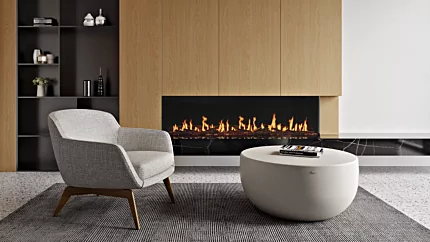
thumbnail: webimage-Motion-76RC-Electric-FireplaceMotion 76RC - Residential Space CGI

What is electric fireplace flame technology?

An electric fireplace flame is a simulated visual effect produced by one of four technology families, mechanical LED, water-vapour mist, holographic projection, or screen-based video, designed to mimic the look of a real fire without combustion.

Why the technology family matters: realism, customisation, audio, indoor or outdoor approval, and running cost all shift depending on which approach the unit uses. A mechanical LED fireplace can be perfectly fine as a budget bedroom accent and still look obviously synthetic from a metre away. A high-definition video display in the same room will read as real fire from across the lounge. Same heat output, same wall, completely different room.

This guide stays focused on the flame itself. For a broader purchase walkthrough covering sizing, mounting style, smart controls, and warranty, the electric fireplace category page is the better starting point.

The four main types of electric fireplace flame technology

Almost every electric fireplace on the market today uses one of four approaches. We've ordered them roughly by how common they are, starting with the technology that has filled the budget segment for two decades and ending with the screen-based and zone-LED systems that now define the premium end.

Mechanical LED flame technology (rotating reflectors)

Mechanical LED flame technology uses spinning rods or rotating reflectors to break light into moving patterns projected onto a screen, creating the illusion of dancing flames. It has been the budget-segment standard since the early 2000s and the underlying mechanics have barely changed.

The foundational US Patent 6,757,487B2, filed by Colm Martin and colleagues in 2004, describes the system in exact detail: a rotating hollow cylinder with patterned openings (the "light randomizer"), a coloured filter screen silk-screened in yellow, red-orange, and blue translucent zones, and a partially translucent diffuser at the back of the firebox. As the cylinder turns, light passes through the openings, bounces between the reflective panel and the filter, and projects upward-moving patterns onto the diffuser. The whole flame assembly is about 4 inches deep.

Industry consultant Mabelle Shen describes the modern equivalent as "the coordinated cooperation of three major components: LED lights + flame panel + reflector," where the rotating reflector blade refracts light onto the flame panel through rotation. It's elegant, mature, and cheap to manufacture. It is also, on close inspection, repetitive: the same loop of patterns plays every few seconds. No sound. Minimal colour customisation. Indoor only.

3D water-vapour flame technology

3D water-vapour flame technology uses ultrasonic transducers to atomise water into a fine mist, which is lit from below by LEDs to produce a three-dimensional, flame-like plume that appears to rise from the fuelbed.

The mechanics are a four-part system. An ultrasonic atomiser vibrates water at high frequency to produce a floating mist layer. A heating plate controls the rise speed and density of that mist. Side- or under-mounted LEDs illuminate the column from within, and the translucent nature of the vapour means the effect is genuinely three-dimensional rather than projected onto a flat surface. The technology is most often deployed in mid- to large-format inserts where the mist column has room to develop.

Trade-offs are real. The unit needs a water reservoir, the reservoir needs periodic refilling, and the mist column is sensitive to airflow, which means an open doorway or a ceiling fan can disturb the plume. These fireplaces typically cannot be wall-mounted because the reservoir and atomiser need a cabinet to live in. Indoor only.

Holographic flame technology (Pepper's Ghost)

Holographic flame technology uses a beam-splitter glass angled at 45 degrees to reflect a hidden video of real flames into the viewer's eye line, a modern application of the centuries-old Pepper's Ghost stage illusion.

The Pepper's Ghost trick was first used in Victorian theatre to make ghostly figures appear and disappear on stage. The fireplace adaptation hides a top-mounted LCD inside the cabinet, plays high-definition footage of real fire on it, and projects that footage onto angled specialist glass positioned above a physical log set. The brain fuses the projected flame with the real logs underneath and reads the scene as fire rising from the fuelbed. LED underlighting in the ember bed fades in sync with the flame footage to deepen the illusion.

Realism is the strongest of the four categories, particularly when the unit is viewed from the design sweet spot directly in front. Off-axis viewing degrades the effect because the beam-splitter glass is geometrically tuned to a specific eye line. Install depth is also greater than a mechanical LED unit because the cabinet needs room for both the LCD and the angled glass. Typically indoor only.

Screen-based and zone-LED flame technology (where EcoSmart sits)

The newest pair of approaches are high-definition LCD video displayed directly through toughened glass (Motion Picture) and multi-zone LED rendering with independently controllable flame, ember, and downlight zones (Switch FX). Both are EcoSmart Fire's own systems and they take the category in different directions, one prioritising immersive realism and sound, the other prioritising colour flexibility and outdoor approval. The next two sections cover each in product-specific depth.

Technology

How it works

Realism

Customisation

Maintenance

Indoor / outdoor

Mechanical LED

Rotating reflectors + LED

Low to medium

Low

Very low

Indoor only

3D water vapour

Ultrasonic mist + LED

High (3D)

Medium

High (water refill)

Indoor only

Holographic (Pepper's Ghost)

Angled glass reflects video

High

Medium

Low

Indoor only (typically)

LCD video / zone LED

HD screen or independent LED zones

Very high

Very high

Very low

Indoor / Indoor + outdoor

How EcoSmart Fire's Motion Picture Technology works

EcoSmart Fire's Motion Picture Technology is an LCD-based flame display that runs high-definition flame footage through a screen behind toughened glass, paired with adjustable wood-crackling audio and ember-bed and downlight LEDs in independently controlled zones.

The system gives the user three flame styles, six colour presets per flame style, and three speed levels for the flame movement itself. Beneath the flame display, the ember bed and downlight are separate lighting zones with ten colour options each, a fade transition, and five brightness settings. That stack of independent controls is what produces the layered look on Motion units: a warm amber ember glow, a cooler downlight wash, and a customised flame behaviour all running at once and not bleeding into each other.

Wood-crackling audio is built in with adjustable volume, the multi-sensory element that flat-projection technologies miss entirely. The brain processes flame as a unified sight-and-sound experience, so adding the audible cue closes one of the largest perceptual gaps between simulated and real fire.

LED draw is between 30 watts on the Motion 30 and 85 watts on the Motion 120, against a heater output of 1.5 kW (5,118 BTU/hr) at 120 V or 3 kW (10,236 BTU/hr) at 240 V. That contrast is the practical point: running the flame alone, as ambient lighting, costs roughly what a household lamp costs to run. The heater is the expensive draw and you choose when to switch it on.

A short note from the support documentation that surprised us when we read it: the "Home" button restores all user settings to factory default and the unit takes 20 to 30 seconds to boot from a cold start because the display is loading firmware before the first frame plays. Worth knowing if you're showing the fireplace to a client and you don't want a guest puzzling over a dark screen. The Motion range is indoor only and the cabinet profile is 9.4 in (239 mm) deep. The 30 in unit suits apartments and smaller lounges, the 76 in lands in family-room scale, and the 120 in option is architectural scale for a feature wall.

How Switch FX Technology works (and why it's outdoor-approved)

Switch FX Technology is a zone-based LED system with three independently controllable zones, flame, ember bed, and downlight, each driven by a full-spectrum colour wheel, a brightness slider, and four speed settings.

The colour wheel is the headline feature. Beyond the eight preset modes (orange, red-orange, golden orange, green, aqua, blue, magenta, and a multi-colour cycle), the user can dial any hue across the visible spectrum, on any of the three zones, independently. A specifier matching a hospitality brand palette can tune the flame to a precise corporate colour and leave the ember bed in a complementary warm tone underneath. That depth of customisation doesn't exist in preset-only systems.

Switch FX is approved for both indoor and covered outdoor use, the only one of the four technology families in this guide engineered for verandas, pergolas, and pool houses. The unit must sit under a roof, overhang, or pergola cover and must not be directly exposed to rain. That restriction matters: outdoor electrical equipment in general follows the ingress protection framework set out in IEC 60529, the international standard that governs how enclosures are rated against dust and water, where IP44 is the minimum threshold for general outdoor use and IP65 is required for direct weather exposure. A covered patio takes a Switch FX out of the direct-exposure category and into the protected-outdoor envelope it was designed for.

LED draw on the Switch range runs from 42 watts on the Switch 44 to 106 watts on the Switch 120. The cabinet is a little deeper than Motion at 11.5 in (292 mm) because the LED architecture and outdoor-rated electrical sealing both demand more internal volume. Heater output matches the Motion range at 1.5 kW (5,118 BTU/hr) at 120 V or 3 kW (10,236 BTU/hr) at 240 V. Sizes step from 44 in to 120 in.

Loading image...

thumbnail: webimage-Switch-44BY-Electric-FireplaceSwitch 44BY - Residential Space CGI

Motion Picture vs Switch FX: which flame technology is right for you?

Both systems sit at the premium end of the category, but they solve different problems. Motion Picture prioritises immersion and sound. Switch FX prioritises colour control and outdoor approval. The decision is rarely about which is "better" in the abstract, it's about which one suits the room.

Feature

Motion Picture (Motion range)

Switch FX (Switch range)

Display approach

LCD video, three flame styles

Zone-based LED, three independent zones

Colour customisation

6 presets per flame style

Full-spectrum colour wheel + 8 presets

Audio

Wood-crackling sound built in

Visual only

Indoor / outdoor

Indoor only

Indoor and covered outdoor

Depth

9.4 in (239 mm)

11.5 in (292 mm)

LED draw range

30 to 85 W

42 to 106 W

Heater output

1.5 kW (5,118 BTU/hr) at 120 V; 3 kW (10,236 BTU/hr) at 240 V

Same

Sizes available

30, 52, 60, 76, 100, 120 in

44, 56, 68, 80, 96, 120 in

Best for

Living rooms and primary lounges where immersion and sound matter

Outdoor entertaining areas, hospitality, colour-matched interiors

Flame technology and energy: the LED-versus-heater story

An EcoSmart Fire electric fireplace draws between 30 and 106 watts in flame-only mode and up to 3 kW when the heater runs at 240 V, meaning the year-round ambience cost is a fraction of the heating cost.

Flame-only mode is the underrated feature of the entire category. With the heater off, the fireplace becomes an ambient light source running at roughly the same wattage as a household lamp, which is why most owners leave the flame display running through summer evenings without thinking about the meter. Independent industry data backs this up: Bryan Hindman, a licensed electrician, notes that ambiance-only mode "consumes minimal power, usually around 30 to 50 watts, which is comparable to a standard lightbulb," while the heating element is the part that draws the real current.

A point of honesty that competitor articles tend to skip: a 1.5 kW (5,118 BTU/hr) heating element on a 120 V circuit is a supplemental heat source, not a primary one. EcoSmart's own support documentation says exactly that. The unit is sized to add comfort warmth to a single room of roughly 400 square feet, not to replace ducted heating across a house. Comparative running cost sits in two clear tiers, light-bulb-tier when the flame runs alone and small-space-heater tier when the element kicks in.

A practical aside on the electrical side: the heating element pulls about 12.5 amps on a 120 V circuit, which is fine on a dedicated 15 A or 20 A run but tight if you've already loaded the circuit with other appliances. Worth flagging to the electrician before installation. The electric fireplace selection details the circuit requirements on each product page.

Choosing the right flame technology for your space

The flame technology decision is mostly a question of matching the priorities of the room. Three patterns cover most situations:

  • If you want the most immersive ambience for a primary lounge, Motion Picture pairs HD video with wood-crackling audio, the closest electric simulation gets to the multi-sensory experience of a real fire.

  • If your space is a covered outdoor terrace, pool house, or pavilion, Switch FX is the only one of these technologies approved for that environment. That single fact often makes the decision for you.

  • If you want to match flame colour to a brand palette or a seasonal interior scheme, Switch FX's full-spectrum colour wheel goes further than any preset-only system, with independent control across flame, ember bed, and downlight zones.

Beyond the flame itself, the practical questions of wall-mounting versus recess, the safe envelope for a TV above the fireplace, and apartment-specific considerations like sub-floor reinforcement and rental approvals all sit alongside this decision. Each of those is a topic in its own right, and the broader Electric Fireplaces collection is the central hub for the supporting guides.

A quick word on bioethanol if you want a real flame

Electric flame technology is, by definition, a simulation. The best LCD video systems are extraordinary at simulation, but some readers genuinely want a real flame: the gentle heat, the soft sound, the slight movement of air that no LED can produce. That's a different decision and a different product family.

Bioethanol fireplaces deliver an actual flame with no flue or chimney requirement, which means the design freedom is closer to electric than to wood or gas. Trade-off is real fuel cost and periodic refilling. If you've landed on electric for the zero-fuel side of the equation, stay where you are. If a live flame is the priority, EcoSmart Fire's bioethanol range is the natural next step.

Frequently asked questions about electric fireplace flame technology

Which electric fireplace flame technology looks the most realistic?

Holographic projection and high-definition LCD video displays currently produce the most lifelike electric flames because they reproduce real flame movement rather than simulating it mechanically. EcoSmart Fire's Motion Picture Technology adds wood-crackling audio to the HD flame footage, a multi-sensory effect that flat projection and mechanical LED systems can't match.

Can any electric fireplace flame technology be used outdoors?

Most electric fireplace flame technologies are indoor only. EcoSmart Fire's Switch FX Technology is approved for covered outdoor use, verandas, pergolas, and pool houses, provided the unit is not directly exposed to rain or weather. Standard indoor electric fireplaces lack the weatherproofing required for outdoor environments and should never be installed without a manufacturer-approved outdoor rating.

Does the flame technology affect running cost?

Yes. Flame-only mode on an EcoSmart Fire electric fireplace draws 30 to 106 watts depending on size, comparable to a household lamp. The 1.5 to 3 kW heater is the main electricity draw, and it can be switched off year-round while keeping the flame display running, which is why owners typically run the ambience all summer and add the heat only on cool evenings.

Conclusion: flame technology is a design decision, not just a spec sheet

Flame technology shapes the atmosphere of a room more than any other electric fireplace specification. The four families, mechanical LED, 3D water vapour, holographic Pepper's Ghost, and screen-based or zone-LED, each produce a different kind of presence, and the right one for your space depends on whether realism, customisation, audio, or outdoor approval matters most.

EcoSmart Fire's two systems sit at the design-flexible and immersive ends of that spectrum. Motion Picture brings HD video and wood-crackling audio for primary lounges where the fireplace carries the room. Switch FX brings full-spectrum colour control and covered-outdoor approval for patios, hospitality, and design-led interiors. To compare both ranges side by side, the EcoSmart Fire electric fireplaces collection is the most useful next step.

References

Related Articles

TV Above the Electric Fireplace: Design Strategies, Height & Heat Considerations

Others
Design strategies for mounting a TV above an electric fireplace safely.

Electric Fireplaces for Hotels & Commercial Spaces: Design, Safety & Compliance

Design Trends
Hotel electric fireplaces: design, safety, compliance, and cost overview.