Loading image...

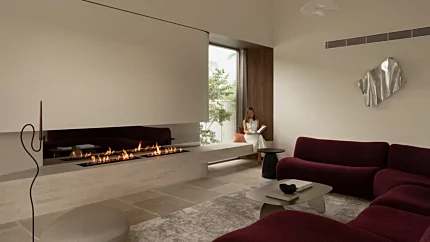
 © FUFU Kyu-Karuizawa, Restful Forest
 The accepted wisdom on ethanol burners runs like this: linear burners are the architectural choice, round burners are the centrepiece choice, and if you want the most heat, you go long. The first two are true. The third is wrong. Inside the EcoSmart Fire range, the highest-output burner is round, not linear, and once you understand why, the linear vs round ethanol burners decision stops being about heat and becomes about something more interesting: the kind of flame the room is built around.
This guide compares the two shapes across the five lenses that actually matter when you're specifying a burner: flame character, heat output, fuel capacity and burn time, install geometry, and use-case fit. Real BTU and burn-time figures throughout, drawn from our own product data, with the design context to make a confident call.
Loading image...
© FUFU Kyu-Karuizawa, Restful Forest Linear ethanol burners suit architectural recesses and continuous ribbon-flame installations along walls, benchtops and islands. Round ethanol burners suit freestanding, table-top and centrepiece fires where the flame is meant to gather attention from every angle. So far, conventional. The surprise sits inside our own range: the round AB8 produces 20,433 BTU/h (6 kW), more than any linear burner we make.
Comparison | Linear (XL series) | Round (AB series) |
|---|---|---|
Flame character | Elongated horizontal ribbon | Cylindrical, radial, campfire-style |
Peak heat output | 15,290 BTU/h (4.5 kW), XL1200 | 20,433 BTU/h (6 kW), AB8 |
Peak burn time | 9–14 hours, XL1200 | 7–9 hours, AB8 |
Ideal setting | Recessed walls, media walls, joinery, hospitality | Freestanding, tables, courtyards, centrepieces |
Design intent | Continuous line, panoramic flame | Focal point, gathered presence |
The surprise: if the brief is maximum radiant heat from a compact footprint, the round AB8 outperforms every burner in the linear range. It also heats the same 60 m² living area that an XL900 would heat, but from a 360 mm × 360 mm cutout instead of a 900 mm length.
A linear burner produces a long, low ribbon of flame that reads as a continuous band of light. The eye follows it left to right rather than settling on one point. Because the flame line is elongated, individual flame tips appear to chase each other along the burner, creating a sense of horizontal movement that's particularly effective behind a wide media wall or above a benchtop run. The XL Baffle inside our linear models pulls air evenly across the full length of the burner channel, which is what keeps the flame line consistent from one end to the other rather than fluttering toward whichever end happens to be closer to a draft.
A round burner produces a cylindrical column of flame that gathers upward in a circle, more like a contained campfire. The flame is radial. It reads the same from every angle, which is the whole point when the burner sits in the middle of a table, a courtyard or a dining setting where guests are seated around it. The AB8 uses an Efficiency Ring to concentrate combustion around the burner's perimeter, which gives the round flame a denser, more sculptural quality than you'd get from a simple cylindrical fuel bowl. The smaller AB3 takes a different approach: a steel-wool fill stabilises a smaller flame at lower fuel volumes, which is useful in a table or accent application where a tall flame would be unwelcome.
The contrast in three lines each:
Linear flame traits
- Horizontal movement, eye travels along the line
- Reads at distance, works well on long sight lines and behind glass
- Sits flat in a recessed channel, not above it
Round flame traits
- Radial presence, equally readable from any seat
- Concentrated upward column, gathers the room toward it
- Sits in or above an opening, visible from above as well as side-on
Choose linear when the design language is a horizontal line. Choose round when the design language is a focal point. The flame character should sit in the design first, not the other way around.
Loading image...

 © Comma Projects and Alyne Media
 The AB8 round burner produces 20,433 BTU/h (6 kW), the highest in the EcoSmart Fire range, more than any linear model we make. That single figure overturns the assumption that runs through most ethanol burner content online: longer burner equals more heat. It doesn't. Geometry matters more than length.
Here's the data, in full:
Model | Shape | Heat output | Heated area |
|---|---|---|---|
AB3 | Round | 5,800 BTU/h (1.7 kW) | ~20 m² |
XL500 | Linear | 11,400 BTU/h (3.3 kW) | 40 m² |
XL700 | Linear | 13,650 BTU/h (4 kW) | ~50 m² |
XL900 | Linear | 13,650 BTU/h (4 kW) | 60 m² |
XL1200 | Linear | 15,290 BTU/h (4.5 kW) | 40–65 m² |
AB8 | Round | 20,433 BTU/h (6 kW) | 60 m² |
The reason the AB8 outperforms the linear range comes down to fuel chamber depth and combustion geometry. The AB8 is a deeper burner, 152 mm of depth against 112 mm in the XL series, which gives it more fuel surface area per square millimetre of footprint and a richer vapour pool above the fuel line. The Efficiency Ring concentrates that combustion in a tight perimeter rather than letting it spread laterally. The result is more BTU/h from a 360 mm × 360 mm cutout than from a 900 mm linear channel.
The peer-reviewed research backs the general direction. A 2025 study in Applications in Energy and Combustion Science led by Jiří Ryšavý and colleagues compared single-chamber and double-chamber bioethanol burners and found single-chamber designs delivered 11–31% higher average heat output. Linear and round burners in our range use single-chamber construction (confirmed across the XL and AB product documentation), but the chamber geometry inside each one differs significantly, which is where the AB8's combustion advantage comes from.
The practical translation: if maximum radiant heat from a compact footprint is the priority, the round AB8 is the answer. If a long, lower-intensity flame line stretched along an architectural feature is the priority, a linear burner is the answer. Both heat the same 60 m² room. They just do it from very different presences inside it.
One honest caveat. A 2020 study by the same Ostrava research group, published in ACS Omega, found that actual heat output in real operating conditions averaged 41–62% of declared figures across the bioethanol burner category. That applies industry-wide and reflects the gap between calorimetric peak and a real room with real ventilation. The relative ranking between models holds; the absolute numbers should be read as peak figures, not floor figures.
Round burners win the heat output contest. Linear burners win the endurance contest. The XL1200 holds 10 L of fuel and runs for 9–14 hours on a single fill; the AB8 holds 8 L and runs for 7–9 hours. The elongated form of a linear burner buys reservoir volume without raising the flame height, which is why the longest model in the linear ethanol burner range is also the longest-burning.
For most residential evenings this gap doesn't matter. A two-hour dinner, a Sunday afternoon in front of a fire, a relaxed evening in the lounge: both shapes finish the night with fuel to spare. The gap starts to matter when the use pattern stretches.
Where it actually counts:
Hospitality services that run from dinner through to close, where a single fill needs to cover a four to six hour sitting
Hotel lobbies and lounge areas where staff don't want to refuel during peak hours
Restaurants and venues with long, continuous operating windows
Holiday rentals where guests expect a fire to be on without intervention
The XL700, for example, sits in the Park Hyatt Niseko Hanazono, exactly the kind of setting where a continuous flame across a long architectural opening earns its keep, and where the burn-time-to-fill ratio becomes part of the operational case. For a typical living room, the difference between nine hours and fourteen is academic. For a commercial venue, it's the difference between one refuel and two.
Burn-time comparison | XL1200 | AB8 |
|---|---|---|
Fuel capacity | 10 L | 8 L |
Burn time | 9–14 hours | 7–9 hours |
Heat output | 15,290 BTU/h (4.5 kW) | 20,433 BTU/h (6 kW) |
There's a small irony in this. The burner that puts out the most heat (AB8) is also the one that empties fastest. Higher BTU/h means higher fuel consumption per hour, which means a shorter run from the same volume. That trade-off is geometry's, not the burner's fault.
The shape decision becomes physical at the firebox. Linear burners drop into rectangular recesses. Round burners need symmetrical cutouts. That distinction has practical knock-on effects across joinery, glass and bespoke surround work.
The XL series shares a constant 195 mm width and 112 mm depth across all four lengths. The footprint detail you draw for an XL500 is the footprint detail you draw for an XL1200; only the length changes. For a designer iterating between burner sizes late in a project, that's a meaningful flexibility: you can swap an XL900 for an XL1200 without redrawing the recess depth or rerouting the joinery. The AB series uses square cutouts: AB8 at 360 mm × 360 mm × 152 mm deep, AB3 at 260 mm × 260 mm × 92 mm.
Dimension | XL500 | XL700 | XL900 | XL1200 | AB3 | AB8 |
|---|---|---|---|---|---|---|
Width | 195 mm | 195 mm | 195 mm | 195 mm | 260 mm | 360 mm |
Length | 545 mm | 700 mm | 905 mm | 1,200 mm | 260 mm | 360 mm |
Depth | 112 mm | 112 mm | 112 mm | 112 mm | 92 mm | 152 mm |
Minimum firebox width: 800–1,500 mm for the linear series depending on length, 800 mm for the AB8. None of those numbers are especially demanding for a built-in project, but the difference between rectangular and symmetrical does matter for one specific element: the windscreen.
A linear windscreen is straightforward fabrication. Flat glass panels, mitred or butt-jointed corners, off-the-shelf tempered glass thicknesses. A round or curved windscreen is a different proposition. Curved glass means custom moulding, custom tempering, longer lead times, and a step up in cost that bespoke joiners find out about the hard way on the first quote. Wherever a windscreen is needed, whether outdoors, in a draughty hallway or on a balcony, a linear burner with rectangular glass will be substantially easier and cheaper to surround than a round burner with a curved one. It's worth flagging that early in the specification process rather than late.
For the materials around the cutout itself, the same non-flammable rules apply regardless of shape. The detail there belongs to its own discussion, but the short version is steel, masonry, mineral panels, stone: anything rated for direct flame contact, never timber, plasterboard or untreated MDF inside the clearance zone.
A practical performance lens that almost nobody writes about: how each shape handles moving air. A linear burner installed in a channel or recess is shielded on three sides by the surround itself. The flame line sits below the top edge of the recess, so cross-draft has to come down into the channel before it reaches the flame. That makes linear burners structurally calmer in still indoor air and gives them a real advantage on covered terraces and verandas where intermittent breezes pass overhead.
A round burner in a freestanding bowl, a table fire or an open centrepiece is exposed in every direction. There's no surround mitigating air movement, so the flame is more responsive to whatever the room is doing. Indoors this often reads as visual richness, as the flame dances a little, which makes the fire feel alive rather than static. Outdoors, on a balcony or in a courtyard with crosswinds, that same responsiveness can become a problem. The flame can be pushed off-axis or lifted at the edges, and in stronger gusts it can flicker low enough to look uncertain.
The implication splits cleanly. Indoors and in still air, both shapes perform beautifully and the choice goes back to design. Outdoors in a windy position, a linear burner in a channel surround or a round burner inside a bespoke windscreen will be the steadier choice. A round burner sitting open on a windy terrace will be the most visually compelling option on calm evenings and the most frustrating one on the rest of them.
A short note on clearances, because they shift outdoors. The minimum overhead clearance indoors is 1,500 mm. Outdoors, that increases to 2,000 mm. Lateral clearance stays at 600 mm in both settings. These are universal across our ethanol burners collection and they're the safety floor, not a recommendation. The fuller clearance schedule covers ceiling materials, adjacent surfaces and TV positioning, and that's the right place to go for installation depth rather than this article.
Loading image...
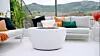

The decision condenses to two questions. What is the flame doing inside the room: running along a line or anchoring a circle? And where does it have to sit: recessed into architecture, or out in open space?
Choose linear for:
Architectural wall integrations and media walls where the flame extends below or beside a screen
Long benchtop, island and bar-front installations where a continuous flame line follows the joinery
Zero-clearance cabinetry and bespoke residential builds where the surround is part of the design language
Hospitality venues needing long burn time and a continuous flame across a wide opening (Park Hyatt Niseko Hanazono specified the XL700 for exactly this reason)
Mid-century, contemporary and minimalist interiors where horizontal line is the dominant gesture
Outdoor terraces and covered patios where a recessed channel will buffer the wind better than an open bowl
Choose round for:
Freestanding sculptural fires that work as centrepieces in their own right
Dining-table centrepieces and conversation-circle settings where the fire is meant to be approached from every side
Portable accent fires on side tables and console runs (our ethanol burners range has compact options for these settings)
Courtyard centrepieces in protected positions, particularly where the AB8's heat output earns its place
Settings where maximum radiant heat from a compact footprint matters more than visual length
Curved or cylindrical bespoke fireplace surrounds where a linear cutout would fight the geometry
There's a third option worth mentioning briefly: the square BK5 burner. It sits between the two, neither a long ribbon nor a true circle, and works well in projects where the design language is geometric but the proportions don't suit either a linear band or a round bowl. Useful to keep on the shortlist for square coffee tables, square planter-style fires, and built-ins where the cutout proportions favour a one-to-one ratio.
The right way to make the call is to start with the room and the role the fire is playing inside it. A homeowner will usually read the fire as atmosphere; a designer will usually read it as composition; a specifier will usually read it as a brief with a budget and a delivery deadline. All three answers point in the same direction if the design question gets answered first. Heat output sorts itself out once the shape is right.
Three steps, in order:
Start with the design. Linear ribbon, or round flame. Architectural line, or focal centrepiece. Get this right and the rest narrows quickly.
Confirm the setting. Recessed into joinery or wall, or open in a freestanding position. Indoors in still air, or outdoors with crosswinds. The setting tells you whether windscreen and draft become live questions.
Match heat output and burn time to the room and the use pattern. A 60 m² residential lounge has different needs from a 60 m² hotel lobby that operates eight hours an evening.
And the signature takeaway one more time, because it's the most useful thing in the article: round does not mean small heat. The AB8 puts out 20,433 BTU/h (6 kW) from a 360 mm square cutout, more than any linear burner in our range. If the brief is maximum radiant warmth from a compact, sculptural form, the round shape is the answer, not the long one.
For room-by-room sizing methodology, the dedicated sizing guide goes into more depth than this comparison needs to. For ongoing care, the maintenance routine is identical across both shapes: burner cleaning, wick checks, fuel handling, all the same regardless of geometry. And for the full lineup of both linear and round options, the cluster page sits above this article with every model side by side.