Blog

  /  

How Much Heat Does a Bioethanol Fireplace Produce? BTU Output & Room Sizing Guide

How Much Heat Does a Bioethanol Fireplace Produce? BTU Output & Room Sizing Guide

A fireplace that looks beautiful but leaves the room cold is a sculpture. One that overpowers a small lounge is a sauna with better styling. Finding the right answer has less to do with the fireplace you fall in love with than with the space you're asking it to warm. Bioethanol fireplace heat output is published openly, burner by burner, which means the sizing question is genuinely answerable before you buy. The numbers only become useful, though, once you know how to read them against your floor area, your ceiling height, and the way you actually plan to use the fire.

Published:
· Updated:

Loading image...

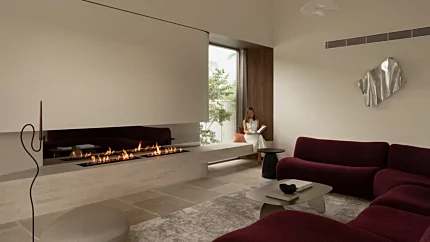
thumbnail: webimage-XL900-Ethanol-BurnerXL900 Ethanol Burner by EcoSmart Fire delivers contemporary indoor heating for Hipwell Haus by Tim Neve living and lounge areas.

The short answer: typical bioethanol fireplace heat output

Bioethanol fireplaces typically produce between 5,800 and 20,433 BTU/h (1.7 to 6 kW) per burner, depending on burner capacity and flame setting. Multi-burner installations extend that range considerably, with the largest configurations in the EcoSmart Fire range reaching up to 45,870 BTU/h (13 kW) across three burners.

That spread tells you something important straight away: there is no single answer to “how much heat does a bioethanol fireplace produce?”, because the burner inside the fireplace is what determines the output, not the fireplace shell around it. A compact tabletop fire and a large built-in installation can share the same design language while delivering very different warmth, and two fireplaces of similar visual scale can house quite different burners.

The other thing worth knowing early is that the figures above describe delivered heat, not theoretical heat. Because bioethanol burns without a flue or chimney, nearly all the combustion heat stays in the room rather than escaping up a vent. That changes how the numbers compare with what you may be used to from vented appliances, and it’s a point we’ll come back to.

One thing to set expectations before the sizing guide begins: across the bioethanol fireplaces range, these are supplemental heat sources. They warm the zone you live in, take the edge off a cool evening, and extend a season. They’re not designed to replace a building’s central heating, and the sizing method below is built for that supplemental role.
What determines how much heat a bioethanol fire delivers

The output figure on a specification sheet is the start of the story, not the end of it. Four variables decide how much warmth actually reaches you.

  • Burner capacity. The size of the burner’s fuel tray governs the size of the flame and therefore the heat. Smaller burners such as the AB3 produce around 5,800 BTU/h (1.7 kW); the largest single burner in the range, the AB8, delivers 20,433 BTU/h (6 kW).

  • Flame setting. Most burners are adjustable. The XL-series burners regulate via baffle inserts and can be turned down to roughly 35 to 40 percent of their nominal output at the minimum setting, a behaviour confirmed independently by Ryšavý and colleagues in a 2024 combustion study. The BK5 burner offers three discrete settings, adjusted with the lighting rod.

  • Burn time. Output and duration trade against each other. A burner run at full flame delivers maximum heat over a shorter window; turned down, the same fill stretches across a longer evening at gentler warmth. Burn times across the range run from roughly 7 to 14 hours per fill depending on burner and setting.

  • Fuel quality. Bioethanol fuels vary in purity, alcohol concentration, and additives, and lower-grade fuels produce dimmer or inconsistent flames. e-NRG bioethanol is formulated specifically for EcoSmart burners, which is why it burns with the steady, efficient flame the output figures assume.

The variable that surprises most people is the one that doesn’t appear on any spec sheet: the absence of a flue. A vented gas fireplace can lose around 30 percent of its heat through the vent system. A bioethanol burner has no vent, so the BTU rating and the heat delivered to the room are effectively the same number. When you compare outputs across technologies, compare delivered heat, not nameplate heat; the gap is smaller than the raw figures suggest.

Bioethanol fireplace heat output by format

The format you choose largely decides which burner class you get, and the burner class decides the heating role the fire can realistically play.

Format

Typical burner class

Heat output

Heating role

Tabletop and portable

AB3

5,800 BTU/h (1.7 kW)

Ambience; intimate small spaces

Wall-mounted and freestanding

XL500–XL1200

11,430–15,290 BTU/h (3.3–4.5 kW)

Supplemental residential heat

Built-in insert (Heritage series)

BK5, XL900

13,000–15,000 BTU/h (3.8–4.4 kW)

Supplemental residential heat

Built-in single burner (Flex series)

XL500–XL1200

11,430–15,290 BTU/h (3.3–4.5 kW)

Supplemental residential heat

Built-in multi-burner (Flex series)

2–3 × XL1200

30,000–45,870 BTU/h (8.8–13 kW)

Significant supplemental and feature heat

Fire pits and fire tables

AB3–AB8

5,800–20,433 BTU/h (1.7–6 kW)

Outdoor radiant heat; entertaining

Portable and tabletop fireplaces

Loading image...

thumbnail: webimage-Ark-40-Fire-TableEcoSmart Fire Ark 40 fire table brings eco-friendly ethanol flame to Starfire outdoor patio, round concrete centrepiece.

The smallest formats in the range are ambience-first. The AB3 produces 5,800 BTU/h (1.7 kW), enough to warm the immediate area of a reading corner, a balcony table, or a bathroom. These fires earn their place through presence and flexibility rather than raw warmth.

Wall-mounted and freestanding fireplaces

Mid-range formats step up to the XL-series and BK5 burner classes, delivering 11,430 to 15,290 BTU/h (3.3 to 4.5 kW). This is the band where a fire genuinely changes the temperature of a living room rather than just the mood of it.

Built-in burners and large-format installations

Built-in formats span the widest output range because they scale. Dual- and triple-burner configurations climb to 30,000 to 45,870 BTU/h (8.8 to 13 kW), enough to make a real thermal contribution to a large open-plan space or a double-height room.

Fireplace grates in existing hearths

For homes with an existing masonry fireplace, retrofit grates convert the hearth to bioethanol without renovation. Burner classes here run from the XL500 up to the AB8, so output spans 11,430 to 20,433 BTU/h (3.3 to 6 kW).

What size bioethanol fireplace do I need? A step-by-step sizing method

To size a bioethanol fireplace, calculate your room volume (floor area multiplied by ceiling height), confirm it meets the minimum volume for the burner you’re considering, then match the burner’s coverage rating to your floor area and intended heating role. Most living rooms of 35 to 60 m² suit a mid-to-large single burner in the 13,000 to 15,000 BTU/h (3.8 to 4.4 kW) class.

  1. Measure your space as a volume, not just a floor area. Multiply floor area by ceiling height. Volume matters because heat fills three dimensions, and because the minimum room size for each burner is defined volumetrically.

  2. Decide the heating role. Are you after atmosphere with gentle warmth, genuine supplemental heat layered over central heating, or the primary comfort source for cool evenings in a mild climate?

  3. Check the burner against the ventilation rule. EcoSmart Fire’s guidance requires at least 5.7 m³ [200 ft³] of room volume per 1,000 BTU/h of burner rating at maximum setting.

  4. Match coverage to floor area. Each burner carries an average coverage rating. Pick the burner whose coverage meets or slightly exceeds your floor area for a supplemental role; size up one class if the fire is doing most of the comfort work.

  5. Adjust for room factors, then choose the format. High ceilings, large glazing, open-plan flow, and exposed positions all push you up a burner class.

Room factors that change the calculation

A floor-area number alone is a blunt instrument. The rooms that bioethanol fireplaces are most often specified for are exactly the rooms where simple area-based sizing goes wrong.

Ceiling height and room volume

Warm air rises, and a high ceiling gives it somewhere to go. For ceilings above roughly 3 m, treat the burner’s coverage rating conservatively and move up a class.

Open-plan living and zoned heating

In an open-plan layout, heat migrates. Size against the connected volume the heat can reach, not the notional lounge footprint, and position the fire at the zone you most want to favour.

Glass façades and heat loss

A floor-to-ceiling glazed wall is a beautiful heat exchanger, and it works against you all evening. Size up a burner class for heavily glazed rooms.

Mezzanines, voids, and stairwells

Any vertical connection acts as a chimney for warm air. For these spaces, either size up substantially, accept the fire as a zone heater for the immediate seating area, or specify a larger-format installation designed for the full volume.

Ventilation and air exchange

The 5.7 m³ per 1,000 BTU/h rule works in both directions. It sets a floor on room size for any given burner, and also rewards generous spaces: a large, naturally ventilated room gives you the freedom to specify the biggest burner classes.

Sizing bioethanol heat for outdoor and alfresco spaces

Outdoors, the room-volume logic collapses entirely. There’s no enclosed air to warm, so a fire pit or fire table doesn’t heat a space; it heats the people near it, by radiation. The seating zone is the unit of measurement. Burners across the outdoor fire pit and fire table range run from 5,800 to 20,433 BTU/h (1.7 to 6 kW), with the larger AB8-class burners suited to bigger gathering circles and the compact AB3 class to intimate two-to-four-person settings.

  • Wind matters more than temperature. Moving air strips radiant warmth quickly. Screen or orient the seating zone against the prevailing breeze before sizing up the burner.

  • Semi-enclosed spaces split the difference. A covered terrace or veranda traps a layer of warm air under its roof, behaving partly like a room.

  • Proximity beats power. Pulling the chairs half a metre closer to the flame does more for comfort than the next burner class up.

Sizing for larger projects and professional specification

Large-volume spaces push past what a single burner is designed to do, and this is where the multi-burner and large-format end of the bioethanol fireplace collection earns its specification. Triple-burner built-in installations reaching 45,870 BTU/h (13 kW) make a genuine thermal contribution to spaces that would swallow a standard fireplace’s output without noticing.

  • Calculate the full connected volume and verify it against the 5.7 m³ per 1,000 BTU/h ventilation minimum at the combined burner rating

  • Position the installation relative to seating zones, not architectural symmetry

  • Check the regulatory position early; burners carry UL certification in the USA and EN 16647 BSI certification in Europe and the UK

Climate and season: matching output to how you'll actually use the fire

Two identical rooms in two different climates need different fires. The burner that’s perfectly sized for a four-season climate can be oversized for a warm coastal climate where the heating season is six weeks of cool evenings. The heating-role decision should really be made climate-first.

Climate pattern

Typical heating role

Sizing implication

Mild or warm

The fire covers most of the comfort need on cool evenings

Mid-range burner often suffices as the primary evening heat source

Four-season

Supplemental warmth layered over central heating

Size for the zone you occupy, not the whole heating load

Transitional outdoor focus

Extends terrace and garden use into cooler months

Size by seating zone and exposure, not area

The takeaway: the same burner can be correctly sized or undersized depending on where it lives. Decide what role the fire plays in your climate’s worst realistic evening, then size for that role.

Getting the most heat from the fireplace you choose

Once the size is right, operation decides how much of the rated output you actually feel.

  • Use the flame setting as a comfort tool, not a switch. Run the burner at full output to bring the room up to temperature, then regulate down.

  • Burn high-purity fuel. e-NRG bioethanol is the fuel EcoSmart Fire specifies because its alcohol concentration and purity are calibrated to the burner geometry.

  • Position for radiant line-of-sight. Seating with a clear view of the flame feels warmer than seating around a corner from it, at identical air temperature.

  • Keep the fire out of the airflow. A burner positioned in a draught path hands its warmth to the building’s air circulation instead of to you.

  • In retrofit hearths, seal the chimney. An open flue above a ventless burner is a heat extraction system.

The right size is the one matched to your space

Every heat output question eventually resolves into a sizing decision, and every sizing decision resolves into knowing your space honestly: its volume, its glazing, its connections to other zones, and the role you genuinely need the fire to play in your climate. The published burner figures, from 5,800 to 20,433 BTU/h (1.7 to 6 kW) for single burners and well beyond for multi-burner installations, only become meaningful once they’re read against those realities. The ventless design is a structural efficiency advantage over vented alternatives, which lose up to 30 percent of their heat output through the flue, so every one of those BTUs stays in the room with you. Get the burner class right and the format becomes a pleasure to choose instead of a gamble.

Loading image...

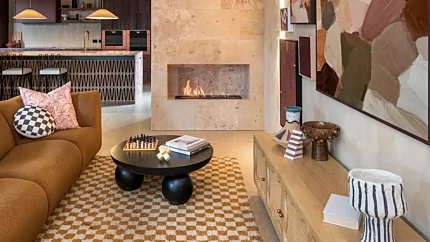
thumbnail: webimage-XL900-Ethanol-BurnerXL900 Ethanol Burner © Comma Projects and Alyne Media

Frequently asked questions

Is a bioethanol fireplace enough to heat a whole room?

For a correctly sized room, yes, in a supplemental sense. A mid-to-large burner producing 13,000 to 15,290 BTU/h (3.8 to 4.5 kW) will noticeably warm a living room of 35 to 65 m² and can carry the comfort load on cool evenings in mild climates.

How do I convert between kW and BTU when comparing bioethanol fireplaces?

Multiply kilowatts by 3,412 to get BTU/h, or divide BTU/h by 3,412 to get kilowatts. A 4 kW burner therefore produces about 13,650 BTU/h.

Does a bigger bioethanol fireplace always produce more heat?

No. Heat output comes from the burner inside the fireplace, not the fireplace’s external dimensions. Always compare the burner rating in BTU/h or kW rather than the fireplace’s physical size.

Can one bioethanol fireplace heat an open-plan living area?

Often, provided it’s sized against the full connected volume rather than one zone’s floor area. A large single burner suits open-plan areas up to around 60 to 65 m², while bigger spaces are better served by multi-burner configurations.

Do outdoor bioethanol fires produce enough warmth to sit by in winter?

In a sheltered or semi-enclosed setting, yes. Exposure is the deciding factor: wind strips radiant heat quickly, so screening the seating zone matters more than adding output.

References

Related Articles

Ethanol Fireplaces

Bioethanol Fireplace Regulations and Compliance Guide

Safety
Bioethanol fireplace compliance guide: UL 1370, EN 16647, ACCC rules.

The Electrification Movement

Technology
The electrification movement is redefining how we power our homes and cities. As nations move to phase out fossil fuels, particularly natural gas, in favour of electricity generated from renewable sources, consumers are rethinking their choices in everything from cars to kitchen appliances to home heating.

Bioethanol Fireplaces for Apartments: Space-Saving Fire Solutions

Buying Guides
Real flame for any apartment — no chimney, flue or utility connection needed.

Bioethanol Burner Technology: How Clean-Burning Flames Work

Technology
How bioethanol burner technology delivers clean, efficient flames.

Bioethanol Fireplace Running Costs & Fuel Budget: What to Expect

Buying Guides
What bioethanol running costs include and how to calculate a realistic budget.