Blog

  /  

Ethanol Fireplaces for Hospitality Venues: Designing Ambiance in Hotels, Restaurants and Bars

Ethanol Fireplaces for Hospitality Venues: Designing Ambiance in Hotels, Restaurants and Bars

A guest steps out of the lift into the lobby of a five-star hotel and the first thing that holds their eye is a wall of glass, behind which a long ribbon of live flame moves quietly against dark stone. The space feels curated, considered, alive. They decide the hotel is the kind of place they want to be before they reach the reception desk.

Now compare that to the lobby next door, where the focal wall is a back-lit logo and a vase of cut flowers. It photographs fine. It says nothing. A cold, generic centrepiece is one of the quietest ways a hospitality venue signals that the design stopped before it was finished.

This is where ethanol fireplaces for hospitality venues earn their keep. A real flame works on atmosphere, dwell time and brand experience at the same time, and because the unit needs no flue, no gas line and no chimney, it can go wherever the design needs it to go.

Published:
· Updated:

Loading image...

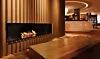
thumbnail: webimage-XL500-Ethanol-BurnerEcoSmart Fire XL500 Ethanol Burner creates a contemporary built-in fireplace for The [m]eatery restaurant, enhancing the indoor dining atmosphere.

What makes ethanol fireplaces suited to commercial settings

Ethanol fireplaces suit commercial settings because they deliver a genuine moving flame with no flue, chimney or utility connection, which frees the design to place the fire feature wherever it serves the guest rather than wherever the building services permit. That single structural fact is the source of almost every commercial advantage that follows.

The first is design freedom. A traditional fire feature drags a flue, a gas run or a masonry stack behind it, and those requirements quietly dictate the floor plan. Remove them and the fire becomes something a designer positions for effect, a focal wall in a lobby, a divider between a bar and a dining room, a low band of flame along a reception desk. The technical groundwork still matters, and clearances and room volumes are real constraints, but the placement conversation starts from intent rather than from the building's service routes.

The second is the flame itself. Guests can tell the difference between a moving, living flame and a simulated effect, even when they cannot articulate why. The real thing carries the small irregularities, the slow shift of light across a face, the warmth on the back of a hand, that a screen cannot fake. In a venue selling experience, that authenticity is the product.

A few advantages tend to matter most when a venue is being fitted out or refreshed:

  • Placement is led by the design, not by where a flue or gas line can run

  • A working flame reads as authentic in a way a simulated effect does not

  • Fit-out is fast and low-disruption, with no gas fitter, electrician or plumber to coordinate for a bioethanol installation

  • The range spans compact freestanding pieces through to architectural feature walls, so the format follows the footprint

The third advantage is speed. Fitting a flue or a gas line into an operating venue means trades, approvals and downtime, and downtime in hospitality is revenue. A self-contained bioethanol feature sidesteps most of that, which is why it suits a renovation as readily as a new build. The heat a feature contributes is a bonus rather than the brief, and these appliances are not designed as a primary heat source. For the detail on output and coverage, our guide to ethanol fireplace heat output covers the numbers, and our ethanol fireplace ventilation guide covers the air-exchange side that any indoor installation depends on.

A real flame without the flue, gas line or chimney

The absence of a flue is the design unlock that everything else hangs from. Because the appliance is self-contained, it does not need an external wall, a roof penetration or a service riser, which is what makes a basement bar or a deep interior lounge viable as a location for fire. A specifier who has spent a career routing focal features toward the one wall that could carry a chimney will recognise the freedom immediately.

Design formats for different commercial footprints

Commercial footprints vary wildly, from a boutique bar nook to a double-height resort lobby, and the format range is built to match that spread. Compact built-in inserts suit intimate rooms, double-sided and island formats zone open-plan volumes, and long linear burners run along counters and partitions where a wide band of flame does more than a contained box ever could. The point is not that one format wins; it is that the modern ethanol fireplaces range is broad enough that the architecture leads and the product follows.
Designing with fire in hotels

A hotel is really a sequence of rooms a guest moves through, and a fire feature pays off differently at each stage of that journey. The lobby sets the tier, the lounge invites the pause, the dining room frames the meal, and a suite feature turns a good room into a memorable stay. Designing well means matching the scale and the placement of the flame to the emotional job each space is doing.

Lobbies and arrival spaces as the brand's first impression

The lobby is where a property declares what it is, and a fire feature is one of the few elements that registers instantly from the entrance. Designers describe lobbies as spaces with the power to create a grand entrance, both a destination in their own right and a gateway to the rest of the property, and a live flame visible from the threshold does exactly that work. In a large architectural volume, scale is everything; a feature has to hold its own against a double-height ceiling and long sightlines.

This is where the architectural statement formats earn their place. A built-in with a defined frame border reads as a deliberate centrepiece against stone or timber, and a wide single-sided installation can anchor a feature wall that a guest sees the moment the doors open. Where the lobby flows into a lounge or a bar, a double-sided unit lets the same flame serve two rooms at once, which keeps the sightline alive from both sides. Our contemporary ethanol fireplaces span the scale that a grand arrival space demands.

Lounges, lobby bars and quiet corners

Lounges and lobby bars are dwell spaces, and dwell is the commercial point. A flame at eye level near a seating cluster is a strong reason to stay for one more drink, and the longer guests linger the more the space earns. Research compiled by Terrapin Bright Green for Interface's Human Spaces 2.0 report found that hotel lobbies with enriched sensory design carried a 36% higher dwell rate than conventional ones, with fire named among the multisensory elements that make a space worth staying in. That figure covers biophilic design broadly rather than fire features in isolation, so treat it as directional rather than a guarantee, but the direction is consistent with what operators observe.

Quiet corners benefit too. A freestanding piece, including a rotating format that can be repositioned without any utility connection, lets a property add warmth to a reading nook or a corner banquette and move it as the room's use changes through the seasons.

Designing with fire in restaurants

A restaurant sells a meal, but what a guest actually remembers is whether the room felt right from the moment they walked in. A warm focal point shifts the perceived comfort of a dining room, and perceived comfort is what keeps a table relaxed, ordering and in no hurry to leave.

Setting the tone of the dining room

A dining room lives or dies on atmosphere, and a live flame is a tone-setter that lighting alone cannot match. The aim is a focal point that feels generous from across the room without overwhelming the table closest to it, giving the flame presence without letting it interfere with the working reality of service. A single-sided built-in along a feature wall gives the room an anchor; a lower, longer band of flame can run behind a pass or along a banquette wall to wash the space in warmth without stealing a cover. The clean-burning behaviour matters here too, because there is no smoke or soot to manage and no exhaust smell to compete with the kitchen.

Zoning open-plan spaces and private dining

Open-plan dining rooms have an awkwardness that fire solves elegantly. A double-sided, see-through fireplace works as a room divider that separates a bar from the dining floor, or one dining zone from another, while keeping both sides visually connected through the flame. An island format with four open sides does the same job freestanding, in the middle of a volume, with no wall to attach to. Either approach defines territory without building a solid partition that would close the room down.

Private dining rooms are the other obvious home for a fire feature, where a contained flame turns a functional space into something that justifies a premium. Whichever route a restaurant takes, the cleaning rhythm scales with use, and our guide on how to clean and maintain an ethanol burner sets out the cadence a busy kitchen pass should plan around.

Designing with fire in bars and lounges

Bars use ethanol fireplaces because a live flame is the most efficient mood instrument available for the evening trade, drawing guests deeper into the room, extending how long they stay, and supporting the higher-margin late sittings that ambiance makes possible. The interplay of low light and moving flame is the whole game after dark.

Loading image...

thumbnail: webimage-BK5-Ethanol-BurnerEcoSmart Fire BK5 Ethanol Burner built into an indoor restaurant at Hurricane’s Grill & Bar, Australia.

Building atmosphere for the evening trade

Evening trade runs on mood, and nothing sets a low-lit room like fire. As the house lights drop, a flame becomes the brightest living thing in the space, pulling the eye and softening every face it lights. That is not decoration; it is dwell-time engineering. A guest who feels held by a room orders the second and third round, and the late trade is where a bar makes its margin. A live flame anchors a lounge seating cluster in a way that no lighting rig matches, and the most considered bar schemes have been built on exactly that premise, an elevated space that still feels relaxed.

The flue-free construction is what makes the best bar locations possible. A basement bar, a fitted-out tenancy in a tower, a heritage building where you cannot cut a chimney, all of these become candidates for a real flame when the appliance carries no chimney requirement. That is a genuine unlock, because the most atmospheric bar spaces are often exactly the ones a traditional fire feature cannot reach.

Feature walls and back-bar installations

A back-bar is prime visual real estate, and a band of flame behind the bottles is hard to beat. A long linear burner set into a non-combustible surround can run the length of a back-bar or a feature wall, and the XL900 and XL1200 burners are built for exactly these long linear features across bar counters, reception desks and restaurant partitions. Specified into a custom surround, that kind of installation reads as architecture rather than appliance, which is the register a serious bar wants.

Outdoor and semi-outdoor hospitality spaces

Outdoor space is where hospitality fire earns its second life, and it is the part most guides ignore entirely. Rooftop bars, alfresco dining terraces, covered courtyards, poolside lounges and the transitional thresholds between inside and out are all spaces a fire feature can transform, and the commercial logic is straightforward: a warm terrace stays usable later into the evening and deeper into the shoulder seasons, which is more service hours from the same square metres.

The outdoor settings that benefit most from a fire feature share a single commercial logic, more comfortable hours means more service time from the same square metres:

  • Rooftop bars and exposed terraces

  • Alfresco dining terraces and garden seating

  • Covered courtyards and loggias

  • Poolside lounges and cabana clusters

  • Indoor-outdoor thresholds where a room opens onto a deck

What changes outdoors is exposure. An open rooftop deals with wind in a way an interior never does, and that shapes both the format and the placement.

Rooftop bars and exposed terraces

A rooftop bar lives and dies on the view and the mood, and fire adds the warmth that keeps the deck working once the sun is gone. Designers have documented the post-pandemic shift toward weatherproof outdoor hospitality, where fire features sit alongside heaters and retractable covers to make a terrace as desirable in winter as in summer. The experiential goal is simple: give guests a reason to stay outside after it cools, and you extend the trading evening.

A note on product and region here, because it matters at specification. Outdoor fire tables and fire pits in our range include bioethanol formats that are broadly available, while gas variants of those outdoor products are sold for outdoor use only and are not available in Australia. The fuel choice for any given project is confirmed at specification stage against the market the venue operates in.

Covered terraces, courtyards and indoor-outdoor thresholds

A covered or semi-enclosed space behaves differently again, somewhere between a sheltered room and an open deck. A loggia, a covered courtyard or a glazed threshold that folds open in good weather is partially protected from wind, which widens the format options and changes the clearance thinking, since a roof overhead is itself a consideration. These transitional zones are some of the most valuable in modern hospitality, the spaces where a guest feels outside while staying comfortable, and a fire feature is what tips them from pleasant to memorable. The outdoor fire pit and fire table ranges cover this territory, with formats suited to both exposed and semi-enclosed settings.

How architects and designers specify ethanol fireplaces

For a specifier, the great advantage is that a flueless fire feature integrates into the design rather than dictating the floor plan, because there is no chimney route or utility connection to coordinate. That guidance is grounded in real product heritage: the Frame range is backed by more than twenty years of R&D, the XL burner series took a 2009 Hearth & Home Vesta Award, and the Flex range earned a 2020 BIMsmith Best Award, so the specification logic below comes from ranges that have been refined through real projects.

  1. Clarify the design intent and the venue brief. Establish what the fire feature is for, a lobby statement, a room divider, an intimate dining anchor, and let that define scale, sightlines and viewing format before any product is chosen.

  2. Select the format to suit the architecture. Decide between a built-in insert, a freestanding piece or a long linear burner in a custom surround. The Flex range covers customisable built-in and double-sided integration, the Frame range delivers the framed architectural statement piece, and the XL burner family handles bespoke linear features.

  3. Coordinate the surround, cabinetry and materials. With the format set, detail the finish around it, marble, timber, concrete or custom millwork, and confirm that anything close to the flame is non-combustible and that nearby glass is toughened.

  4. Document clearances and integration details for the build. This is where the technical inputs land: overhead and side clearances, room volume, and the air-exchange the installation depends on. The ventilation and heat-output detail belongs in the drawings at this stage.

  5. Plan commissioning and operator handover. Brief the venue team on lighting, extinguishing and refuelling before the doors open, so the feature is run correctly from day one.

EcoSmart Fire runs a dedicated hospitality programme for trade specifiers working through this process. One practical note worth flagging early: in some countries, a building authority approval may be required before installation, and submitting drawings to a local representative is the cleanest way to confirm what a given jurisdiction expects.

Matching the format to the architecture (insert, built-in, freestanding)

The format decision is really an architecture decision. An insert or built-in disappears into the wall and reads as part of the structure, which suits a considered, permanent scheme. A freestanding piece keeps its flexibility and can move as a space evolves, which suits a venue that rezones its floor often. A linear burner in a custom firebox is the choice when the fire needs to be a long architectural gesture rather than a contained object.

Integration, detailing and operator handover

Detailing is where a fire feature either becomes part of the building or sits on it like an afterthought. Recessing the unit, aligning it with the surrounding joinery and resolving the materials at the reveal are what separate a specified result from a retrofit. The handover is the other half of the job, because a feature is only as good as the staff routine that runs it, which is the subject of the next section.

Running an ethanol fire feature in a commercial setting

The day-to-day routine for a commercial fire feature is simple and entirely trainable, which is the reassuring part for an operator weighing one up. A venue does not need a specialist; it needs a clear procedure, a couple of trained staff and a sensible rhythm around service. The routine breaks into refuelling, handling and storage.

Refuelling and the rhythm of service

The refuelling routine is designed to map to service windows naturally. Shut the appliance off at the end of a session, allow sixty minutes for the mechanism to cool, then refuel before the next shift opens. Staff handling the feature should know that the flame can be nearly invisible at the end of a burn, so confirming with the shut-off rather than by sight is the correct call. With that simple step in place, the routine is safe and fully trainable in a single handover session. Ignition uses only the lighting rod and lighter supplied with the appliance, never matches or a separate lighter.

A workable staff routine looks like this:

  • One or two trained staff own the fire feature per shift, lighting it at opening and extinguishing it at close

  • Lighting is done only with the provided lighting rod and lighter

  • The appliance is shut off and left for sixty minutes to cool before any refuelling

  • The flame is never left unguarded while lit

  • A fire extinguisher of the correct class is kept on-site, AB:E in Australia or ABC in the USA

How often refuelling falls relative to service depends on the burner, and burn duration across the range runs into multiple hours per fill, so for many venues a single fill comfortably covers a trading session. Our breakdown of the true cost of running an indoor ethanol fireplace sets out the consumption maths for planning purposes.

Fuel storage, staff handling and durability

These burners are built to commercial-grade specification, stainless steel, rated to run far more hours than any domestic appliance ever will, which is the right expectation for a venue. The maintenance rhythm that keeps them performing is straightforward: a clean every 50 litres of fuel consumed or at the first appearance of black deposits, whichever comes first, which in a high-use hospitality setting typically means weekly or fortnightly attention rather than the occasional clean a home fireplace needs. That is a known, manageable cadence, not an open-ended commitment, and a clean-burning fuel keeps it down further, which is part of why our bioethanol fuel quality guide is worth a read before committing to a supply.

Fuel storage on a commercial premises follows clear rules, and getting them right is part of the operator's compliance picture. Storing more than 20 litres of bioethanol indoors requires permitting, volumes above 40 litres need an approved storage cabinet, and access to fuel should be restricted to trained staff only. The fuel is a flammable liquid and should be stored, labelled and signed in line with local fire codes, with good ventilation maintained in any storage enclosure.

Compliance and safety considerations for public venues

A commercial fire feature should carry the recognised safety credentials for its market, sit well clear of guest traffic and combustible furnishings, and only ever run under trained staff, because a public-occupancy setting carries a higher safety bar than a private home. Meeting that bar is mostly a matter of specifying credentialed product and running it to a clear routine.

On credentials, our burners are certified to UL 1370 in the USA and to EN 16647 in Europe and the UK, and the range is compliant with ACCC requirements in Australia.

Those are the marks a specifier should be confirming for any commercial installation.

The reason a public venue needs to be more careful than a home is volume of people and pace of service: more guests, more movement and staff working at speed around the feature, all of which raise the value of sensible siting. Siting comes down to clearances and traffic. Keep a generous overhead clearance from the flame to anything flammable, indoors that means a minimum of 1,500 mm [59.1 in] to flammable materials, and a side clearance of at least 600 mm [23.6 in] to combustibles. Position the feature away from the busiest guest desire lines and away from soft furnishings, and never leave a lit fire unguarded. Where a building authority approval is needed before installation, submit the drawings to a local representative first. For the technical grounding behind these decisions, our ethanol fireplace ventilation guide and our work on indoor air quality cover the air-exchange and emissions side that any indoor installation has to respect. Independent research has reinforced that adequate ventilation is the controlling factor for indoor air quality with flueless bioethanol features, which is precisely why the ventilation step is non-negotiable rather than optional.

Sustainability and the guest-experience story

There is a genuine brand story in a renewable-fuel real flame, and it reads differently to a guest than a gas burner or a screen pretending to be fire. Bioethanol is produced by fermenting plants such as sugarcane and corn, which classes it as a renewable fuel rather than a fossil one, and the combustion produces no smoke, soot or ash. For a hospitality brand building a sustainability position, that is a story it can tell honestly, provided it tells it carefully.

The careful part matters. The honest framing is renewable feedstock, clean combustion and no flue infrastructure, not an unqualified zero-emission claim. The US Department of Energy describes ethanol as a renewable fuel with achievable lifecycle greenhouse-gas reductions when it displaces petroleum-based fuels, and notes that cellulosic ethanol can cut lifecycle emissions by up to 86% compared with gasoline. The International Energy Agency classes biofuels, with ethanol dominating global supply, among low-emission fuels. Those are credible, attributable points a brand can stand behind, and they are stronger for being qualified rather than inflated.

The sustainability conversation is live in hospitality for a reason. Hotels account for around 1% of global carbon emissions, and the major groups including Marriott, Hilton, Hyatt and Accor have formalised net-zero targets by 2050, which is pushing sustainable design choices across the sector. In Australia, the commercial building sector accounts for roughly 25% of overall electricity use and 10% of total carbon emissions, and hotels in the NABERS programme have recorded average energy-cost reductions of 30 to 40% over a decade of ratings. A real flame is one visible, authentic signal among many that a property building a sustainability position can stand behind, and unlike a data-centre carbon offset, it is something a guest can see and feel on arrival.

Honesty also means acknowledging the complexity. Flueless combustion releases its products into the room it occupies, so adequate ventilation is the precondition for the clean-combustion story to hold, a point the academic literature is consistent on. A brand that pairs the sustainability narrative with a well-ventilated, properly specified installation is on solid ground, and our indoor air quality and ethanol article is the place that case is made in full.

Choosing the right fire feature for your venue

The decision gets much simpler once you map the venue goal to the format rather than starting from a product. At a high level, the logic runs like this:

Venue goal

Format that fits

Statement scale, lobbies, feature walls

Frame architectural built-ins, large single-sided Flex

Zoning open-plan and dual-aspect dining

Double-sided Flex, four-sided island Flex

Bespoke architectural integration, linear features

Custom Flex inserts, XL burners for bar counters and partitions

Flexibility and repositioning

Freestanding Designer pieces (Igloo, Mini T and Orbit, all commercial-rated; Orbit repositions without any utility disconnect)

Outdoor terraces and rooftop bars

Fire pits and fire tables, bioethanol broadly available

The freestanding pieces deserve a specific mention because they cover so much hospitality ground. Within our Designer range, the Igloo is described for lobbies, restaurants, bars and offices, the Mini T for the atmosphere of bars and restaurants, and the Orbit for easy repositioning as a space changes, all of them part of the broader freestanding collection rather than one-off products. For bar-height outdoor settings, the Gin 90 Bar, part of our fire tables range, sits at counter height for exactly that application.

Specific models, sizes and regional availability are always confirmed at specification stage, because the right answer depends on the room volume, the market and the brief. For projects in Australia, all bioethanol ranges in this table are available without restriction; gas-variant outdoor products are confirmed at enquiry for other markets. For the full breakdown of formats before you narrow the choice, our types of ethanol fireplaces guide lays out the freestanding, wall-mounted, built-in and recessed options in detail.

Loading image...

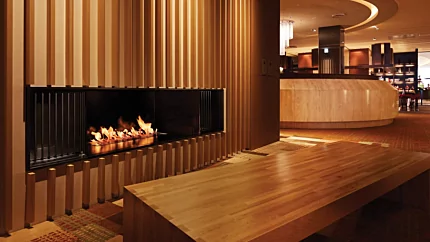
thumbnail: webimage-XL900-Ethanol-BurnerEcoSmart Fire XL900 Ethanol Burner built into Keio Plaza Hotel Sapporo restaurant bar delivers clean-burning ambience for hospitality interiors.

Bringing ambiance to your hospitality venue

The value of a fire feature in hospitality was never in a list of generic benefits. It lives in the match between the right format, the right placement and the specific venue and guests it serves. A lobby wants scale and a clear sightline from the door; a dining room wants a tone-setter that stays out of the way of service; a bar wants a mood instrument for the evening; a terrace wants a reason for guests to stay out after dark. The same technology answers all four, but only when it is specified for the space rather than placed as an afterthought.

The thread running through every one of those spaces is the freedom that comes from carrying no flue and no utility connection. That freedom is what lets a designer place the fire where the guest experience wants it, fit it into an operating venue without tearing the building apart, and extend the same live-flame story from an interior lobby out to a rooftop deck. A well-placed live flame is one of the few design elements that works on atmosphere, brand and dwell time at the same time, which is why the most considered hospitality schemes keep coming back to it.

Get the match right and the flame stops being a feature on a drawing and becomes part of how the venue feels, which is, in the end, the only thing a guest actually remembers.

References

Related Articles

Indoor Fireplaces

How to Create a Cozy Atmosphere with Indoor Ethanol Fireplaces

Choose, place, and style an indoor ethanol fireplace for cozy ambience.

Ethanol Fireplace Ventilation Explained: Do You Need a Chimney, Flue or Vent?

Safety
How ethanol fireplace ventilation works — no chimney or vent required.

Bioethanol Fuel Quality Guide: Why Ethanol Purity Matters for Safety and Performance

Technology
How bioethanol fuel purity and formulation affect safety and performance.