Blog

  /  

Ethanol Fireplace Ventilation Explained: Do You Need a Chimney, Flue or Vent?

Ethanol Fireplace Ventilation Explained: Do You Need a Chimney, Flue or Vent?

You’ve found a fireplace you love, and then the doubt arrives: where does the smoke go, and will the building let you put it there? It’s the question that quietly kills most fireplace dreams in apartments, rendered feature walls, and rooms with no spare wall to break through. With an ethanol fire the answer reshuffles the whole problem, because there’s no flue to run and no chimney to build. What remains is a simpler, more interesting question about the air in the room itself, and that is where the real planning happens.

Published:
· Updated:

Do ethanol fireplaces need a chimney, flue or vent?

Loading image...

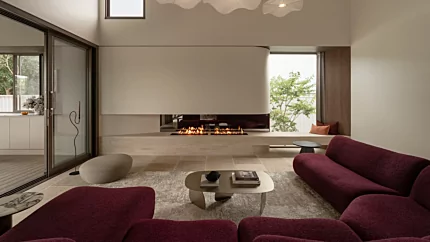
© Victoria Covell Interiors

No. Ethanol fireplaces do not require a chimney, flue, or dedicated vent, because they burn cleanly enough to run flueless, drawing combustion air from the room and releasing nothing that needs to be ducted away. EcoSmart Fire states it plainly across every ethanol range: no flue, no chimney, no connection, no vent.

That single fact is what makes a fire feasible in spaces a traditional hearth could never reach. But “no flue” is not the same as “no air.” Ethanol fireplace ventilation is about the room, not the rooftop, and the distinction between a sealed exhaust route and ordinary fresh-air exchange is what the rest of this comes down to. Get that distinction right and the chimney question stops being a constraint and starts being a choice. Our indoor ethanol fireplaces are all designed around this principle.

Chimney, flue, vent or room ventilation, what’s the difference?

These four words get used interchangeably, and the confusion is what makes people overestimate what an ethanol fire needs. They describe genuinely different things.

Term

What it does

Required for an ethanol fire?

Chimney

A vertical masonry or steel structure that carries smoke and combustion gases up and out of the building

No

Flue

The sealed exhaust passage inside a chimney, or the dedicated pipe a gas or wood appliance vents through

No

Dedicated vent

A fixed opening or duct installed specifically to exhaust an appliance’s combustion products

No

Room ventilation

The ordinary exchange of fresh air in and out of a space, through doors, windows, gaps, or mechanical systems

Yes, in the everyday sense any occupied room needs it

The first three are about getting combustion products out. The fourth is about keeping fresh air in. An ethanol fire eliminates the first three entirely and asks only that the room behave like a normal, breathable room. That is the whole shift in one line.

Why a traditional fire needs a flue and an ethanol fire doesn’t

A wood or gas fire produces smoke, soot, and combustion gases that have to leave the building, so it depends on a flue, a sealed pathway with enough draught to pull those products up and away. The flue is not optional for those fires; it is the safety system. Because a clean-burning ethanol flame produces no smoke, soot, or ash to carry off, there is nothing for a flue to do. Remove the exhaust requirement and you remove the structural dependency that dictates where a conventional fire can sit. Whether you’re considering bioethanol fireplaces for a new build or a retrofit, that freed-up placement is the real prize.

Why ethanol fireplaces can run without a flue

The short version: an ethanol flame leaves nothing behind that a building needs to expel, so there is nothing to vent. That is why every EcoSmart Fire ethanol range carries the same line, no smoke, no soot, no ash, and why a fire can sit in the middle of a room rather than against a chimney breast. EcoSmart Fire’s ethanol burners have been installed in more than 250,000 spaces across 75 countries, in apartments, high-rise lobbies, and hospitality venues where a chimney was never an option.

The mechanism behind that is straightforward combustion chemistry. Liquid bioethanol burns by combining with oxygen drawn from the room, and in a clean burn the primary products are carbon dioxide and water vapour. There is no particulate smoke plume to channel upward, which is precisely why the flue becomes redundant. Real-world combustion is always a function of burner design and operating conditions. Peer-reviewed testing by Ryšavý and colleagues, published in ACS Omega, confirms that bioethanol burners produce carbon dioxide and water as primary outputs, with trace secondary products that depend on burner design, the operative variable measured against the EN 16647 testing standard. Combustion cleanliness rests on fuel quality and a well-engineered burner, not on a chimney. The air-quality side of the question, including how a flueless flame interacts with indoor air quality, deserves its own attention rather than a few lines here.

What ethanol combustion produces (and why there’s nothing to vent)

Loading image...

thumbnail: webimage-Science-of-Bioethanol-2Science of Bioethanol 2

A clean ethanol burn yields carbon dioxide and water vapour. Neither arrives as smoke or particulate, which is precisely why there is nothing for a flue to do. The water vapour disperses into the room air; the carbon dioxide does the same. This is the entire reason a vent is unnecessary, and it is also the reason room airflow still matters, because anything released into the room is shared by the room. That hands the next question to ventilation rather than to ductwork.

How much room ventilation does an ethanol fireplace actually need?

An ethanol fireplace needs no ducting and no flue, but it does need a room with enough natural air exchange for comfortable, complete combustion, the same easy airflow any occupied living space should already have. In typical, non-airtight construction, the ordinary infiltration of air through doors, windows, and the building fabric supplies more than enough.

The practical conditions worth checking are modest:

  • Adequate room volume for the burner’s output, with manufacturer room-size guidance treated as a floor, not a target

  • Periodic fresh air, which most rooms get simply by being used and opened

  • An open door to an adjacent space, or a window cracked open, in smaller or more tightly sealed rooms

  • Avoiding tiny, sealed, unventilated spaces such as bathrooms, which the manufacturer guidance excludes outright

EcoSmart Fire’s own installation guidance leans on a long-standing Underwriters Laboratories ventilation rule of thumb: in a room with limited air space relative to the appliance’s rating, simply keeping a door open or a window cracked restores adequate airflow. It is a low bar, and most living rooms clear it without anyone thinking about it. Because room size is tied to the burner’s output, the minimum-volume figure varies by model, and matching a fire’s heat output and room coverage to the space you actually have is the practical follow-on question. Our indoor fireplaces collection lists room-size guidance per model, with the FAQ at the end of this article pointing you to the specific figures.

Signs a room may need more airflow

The room itself signals what it needs. If anyone in the household has respiratory sensitivities, the same good sense applies as with any open flame: ensure the room is comfortably aired before a long burn, and let the flame itself guide you. A flame that looks weak, lazy, or smaller than usual can indicate the space isn’t getting enough fresh air, and stuffiness or condensation on cold glass after a long burn is the room telling you to open something. The fix is rarely dramatic: a cracked window or an open internal door usually resolves it within minutes.

How ventilation needs change with installation type and build

The flueless answer holds everywhere, but the amount of room airflow worth planning for shifts with how the fire is installed and how the building breathes. The variation is real, and ignoring it is where otherwise good installations get uncomfortable.

A freestanding fire sits in open room air and draws what it needs without much thought. A built-in or recessed unit sits inside a firebox or cabinetry, so the planning moves to the surrounding construction: EcoSmart Fire’s guidance requires insulating air gaps around custom fireboxes, specifically because the air spaces maintain proper temperature and circulation around the burner. The fire still draws combustion air from the room, but the enclosure detailing has to leave that air free to move. Our built-in ethanol fireplaces are engineered around exactly those clearances.

Built-in and recessed installations

Recessed and zero-clearance fireplaces are designed to disappear into a wall or a run of joinery, and that integration is the appeal. The ventilation thinking does not change in principle, the fire still pulls combustion air from the room, but the firebox build must respect the specified air gaps rather than packing them with insulation. Treat the published clearances as the brief, not as a suggestion, and the recessed look behaves exactly like an open one from an airflow point of view.

Airtight modern homes and mechanical ventilation

This is the case that catches people out. High-performance homes, Passive House builds, and sealed modern apartments are designed to leak as little air as possible, which is excellent for energy efficiency and removes the casual infiltration older buildings rely on. The US Environmental Protection Agency, citing ASHRAE, notes that tightly enclosed dwellings may need supplemental ventilation supply for fuel-burning appliances, fireplaces included. In a sealed envelope with mechanical ventilation, the answer is to coordinate the fire with that system, ensure make-up air, and lean on a larger room volume, rather than assuming the building will breathe on its own. It is no accident that architects working on airtight renovations have started bringing flueless-fire specialists into the conversation early.

Closed and automated burners versus open burners

Open manual burners draw freely from room air; closed and automated systems regulate the burn more precisely, giving you more control over the flame without changing the ventilation logic. No duct out; sensible air in.

Ventilation rules and approvals across markets

No chimney or flue obligation applies to ethanol fireplaces in any of the major markets, but the surrounding installation and approval rules differ enough to be worth confirming locally before you commit. The flueless status is consistent; the paperwork around it is not.

In Australia, the National Construction Code’s chimney and flue provisions apply to solid-fuel and insert fireplaces under the relevant Australian standard, and they make no reference to bioethanol or alcohol-fuelled flueless appliances, which confirms that ethanol units fall outside the flue and chimney construction framework. EcoSmart Fire’s ethanol burners are also compliant with the ACCC safety mandate that governs ethanol fireplaces in Australia. In Europe and the UK, the operative standard is EN 16647 for flueless fireplaces, which classifies alcohol-powered decorative appliances as flueless by design and sets the safety and emission requirements that allow indoor use without a chimney. In North America, the equivalent benchmark is UL certification, which EcoSmart Fire’s ethanol burners carry. Across all of these, the chimney question is settled; the open variable is local installation approval.

Residential versus commercial and hospitality venues

Residential installs are generally the simplest, governed by clearances, room size, and good sense. Commercial and hospitality venues are a different matter: restaurants, hotels, and public spaces carry occupancy loads, fire-risk assessments, and local fire-authority conditions that a home never faces. A fire in a busy lobby or dining room may need to satisfy requirements that have nothing to do with the appliance itself and everything to do with the venue. For any commercial or public-venue installation, confirm the conditions with your local authority rather than assuming the residential answer carries over, because the appliance being flueless does not exempt the venue from its own rules.

No chimney needed, so how do you choose?

With the chimney question resolved, the decision shifts to fit, and the questions that matter now are about the room and the look rather than the rooftop. None of them reopen the ventilation problem; they simply route you toward the right model.

For a wall-integrated statement piece, the Flex and Frame ranges are engineered for exactly this scenario, sitting flush into a feature wall or a run of joinery. For a freestanding fire that needs no structural work, the Designer Fireplaces collection includes portable options that are ready in minutes. For a traditional hearth look without the chimney, the Heritage range sits inside an existing fireplace opening and delivers the familiar silhouette with none of the flue obligation.

A few things worth working through in order:

  • Installation style. Freestanding centrepiece, wall-integrated, or recessed into joinery, the format that suits the room and the budget

  • Room size and output. Matching the burner’s heat output to the volume of the space, which also satisfies the airflow guidance covered above

  • Burn time and fuel capacity. EcoSmart Fire burners run from four to eleven hours on a single fill depending on the model, long enough for any evening, and a practical variable to match to how you actually use the fire

  • Build context. Whether you’re working with an open older room or a sealed modern envelope that needs the coordination described earlier

Each of these has more depth than a single line allows, and the contemporary ethanol fireplaces in our range are organised by installation style and room-size guidance so you can find the right fit. The chimney was never the real decision; the fit is.

Frequently asked questions

Do ethanol fireplaces need a chimney?

No. Ethanol fireplaces do not need a chimney, because a clean bioethanol burn produces no smoke or soot to carry away. EcoSmart Fire states across its ethanol ranges that there is no need for a chimney, since burning liquid e-NRG bioethanol does not produce harmful emissions or smoke. For the full detail, see our chimney FAQ.

Do ethanol fireplaces need a vent?

No dedicated vent or duct is required. An ethanol fire draws combustion air from the room and releases nothing that needs a fixed exhaust, so ordinary room airflow, the kind any occupied living space already has, is enough. Our ventilation FAQ covers how much airflow a room needs.

Can you install an ethanol fireplace in any room?

Almost any room, with two sensible limits: the space must meet the model’s minimum room-size and clearance guidance, and very small, sealed rooms such as bathrooms are excluded. EcoSmart Fire’s range spans models with installation guidance matched to each burner, so once you’ve matched the model to the space the answer is usually yes. See our room installation FAQ for the specifics.

Do ethanol fireplaces use up oxygen in a room?

Loading image...

thumbnail: webimage-XL900-Ethanol-BurnerXL900 Ethanol Burner © Comma Projects and Alyne Media

Like any open flame, an ethanol fire consumes oxygen as it burns, which is exactly why adequate room airflow matters. In a normally ventilated room the air exchange more than keeps pace, and keeping a door open or a window slightly ajar in smaller or sealed spaces resolves it comfortably.

The short answer, and what to do next

Ethanol fireplaces free you from the chimney, the flue, and the dedicated vent that have dictated where fires could live for centuries, and they ask for only one thing in return: a room that breathes the way an occupied room already does. That trade is the whole story. The sealed exhaust route a wood or gas fire depends on is replaced by ordinary fresh-air exchange, and the structural problem becomes a comfort one.

The same clean-burn chemistry that removes the flue is what keeps the planning simple, and the same absence of a chimney is what lets a fire sit in an apartment, a feature wall, or the middle of a room that no traditional hearth could ever reach. The variation that’s left, room volume, installation style, and how tightly your building is sealed, is comfortably manageable once you stop looking for a vent that was never needed.

The rooms you ruled out the moment you assumed a fire meant a chimney were, for the most part, available all along. EcoSmart Fire’s ethanol range is built around that freedom, from portable tabletop fires to full architectural built-ins, each one designed for a room that could never carry a chimney.

References

Related Articles

Indoor Fireplaces

How to Create a Cozy Atmosphere with Indoor Ethanol Fireplaces

Choose, place, and style an indoor ethanol fireplace for cozy ambience.

Bioethanol Fuel Quality Guide: Why Ethanol Purity Matters for Safety and Performance

Technology
How bioethanol fuel purity and formulation affect safety and performance.

Ethanol Fireplaces for Hospitality Venues: Designing Ambiance in Hotels, Restaurants and Bars

Design Trends
How to design and specify ethanol fireplaces for hotels, restaurants and bars.