Loading image...

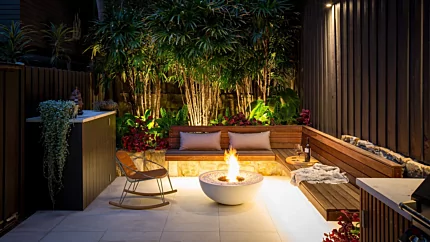
 © @dawncookdesign @bldcdesign / Photo: @suzuranphotography
 What is a bioethanol fire pit?
A bioethanol fire pit is a decorative heating appliance that burns liquid ethanol fuel in a sealed steel burner, producing an open flame without smoke, soot, or the need for a flue. It has two functional parts: the burner, which is the engineered metal chamber that contains the fuel and supports the flame; and the surround, which is the bowl, table, or architectural kit that houses the burner.
The category sits alongside three other fire-pit fuel types, but the differences are sharper than the design vocabulary suggests. Wood produces visible smoke and requires a constant supply of seasoned timber. LP or natural gas needs a fixed gas line or a swappable cylinder, plus the regulator and certification work that comes with combustible-gas appliances. Electric units produce no flame at all; they run a flicker effect behind a glass panel.
Fuel | Smoke output | Flue requirement | Typical heat output |
|---|---|---|---|
Bioethanol | None (complete combustion) | None | 2 to 8 kW (6,800 to 27,300 BTU/hr) |
Wood | Heavy smoke, soot, embers | Required outdoors; flue indoors | Highly variable |
LP gas | None visible; emits CO and water vapour | Typically required for fixed indoor units | 4 to 15 kW (13,650 to 51,200 BTU/hr) |
Electric | None (no combustion) | None | Heater wattage only, no real flame |
Our bioethanol fire pits range covers portable sculptural pieces, larger fixed bowls, and modular kits engineered for built-in installations. Different surrounds, the same underlying combustion principle.