Loading image...


Choosing a fire pit is not just about picking a shape you like. It is a choice between fuels, regulations, and day-to-day realities that will shape every evening you spend around that flame.
Gas fire pits suit open terraces that call for strong, steady heat and minimal effort, especially where a plumbed line is within reach. Wood fire pits appeal to those who want the full campfire experience, from stacking logs to the scent of smoke that lingers long after the embers fade. Bioethanol introduces a different set of possibilities: clean combustion that produces only water vapour and a small amount of carbon dioxide, no flue or gas infrastructure, and certification paths that allow architects and designers to place fire under covers and inside rooms when the right components are specified.
Loading image...
Before comparing performance, it helps to understand what's actually happening inside each fire pit. The combustion mechanism shapes everything that follows: how clean the burn is, how much warmth it throws, where it can sit, and how much work it asks of you.
A gas fire pit burns either liquefied petroleum (LP, from a portable tank) or natural gas (NG, from a plumbed line) through a burner manifold sitting beneath a bed of lava rock or fire-glass. Ignition is push-button or key-valve, the flame settles within seconds, and output is controlled with a regulator. There's no fuel handling once the system is installed. Burners across the gas fire pits collection typically use the G16T or G37T units, producing 65,000 BTU/hr (19 kW). For a deeper walk-through of the combustion cycle, the how does a gas fire pit work FAQ explains the ignition and flame-control sequence in more detail.
A wood fire pit relies on the open combustion of seasoned timber. You build a fire the way a fire has been built for thousands of years: kindling, paper, dry hardwood, patience. Heat output is real but variable; it depends on wood species, moisture content, how the load is stacked, and how the wind is behaving. The combustion is incomplete by design, which is what produces the campfire aroma, the visible flame envelope, and also the smoke, embers, and ash. Heat fades as the fuel breaks down, so the experience is one of continuous tending rather than set-and-forget.
A bioethanol fire pit pours liquid alcohol fuel into a sealed stainless steel burner and ignites it at the surface. The combustion products are water vapour and a small amount of carbon dioxide, with no smoke, no soot, no ash, no flue requirement, and no gas line. Because the flame is clean enough to support indoor combustion when the appliance is certified to EN 16647, bioethanol fire pits are the only category in this comparison that can legally and safely sit inside a building when fitted with the appropriate Indoor Safety Tray. Burner tiers across our ethanol range run from the AB3 at 5,800 BTU/hr (1.7 kW) up to the AB8 at 20,433 BTU/hr (6 kW), with the AB8 rated to warm an outdoor area up to 60 m² (645 sq ft).
Gas fire pits typically output 50,000 to 70,000 BTU/hr (15 to 21 kW), wood fire pits produce variable heat depending on the fuel load (typically 30,000 to 60,000 BTU/hr, or 9 to 18 kW), and bioethanol fire pits produce 5,800 to 20,433 BTU/hr (1.7 to 6 kW) depending on burner size. The numbers matter, but they don't tell the whole story on their own.
BTU is a measure of energy: one BTU is the energy needed to raise one pound of water by one degree Fahrenheit. BTU per hour, then, is a rate, not a total. A larger BTU rating means more heat is being produced each hour, which usually translates to a larger area kept comfortable, but where that heat goes is just as important as how much of it there is. Wind, overhead structures, seating distance, and flame geometry all change what reaches the skin.
Spec | Gas fire pit | Wood fire pit | Bioethanol fire pit |
|---|---|---|---|
Heat output | 50,000 to 70,000 BTU/hr (15 to 21 kW) | 30,000 to 60,000 BTU/hr (9 to 18 kW), variable | 5,800 to 20,433 BTU/hr (1.7 to 6 kW) |
Heat coverage | Large open patios | Variable, wind-affected | Up to 60 m² (645 sq ft) with the AB8 burner |
Burn time per fill | LP: 8 to 20 hr per 20 lb tank. NG: unlimited | 2 to 4 hr per load, requires refuelling | 7 to 11 hr per fill, no reload mid-burn |
Ignition time | Seconds, push-button | 10 to 20 minutes | Seconds, manual lighter |
Flame consistency | Constant, adjustable | Variable, fades as fuel burns | Constant for the full burn |
The honest takeaway is that gas delivers the most usable warmth on an open patio because the output is high and the flame is steady, wood can produce as much heat in short bursts but the average over an evening is lower, and bioethanol is the option to choose when ambience matters more than aggressive output. For a deeper read on what those numbers mean in practice, the how much heat does a gas fire pit produce FAQ walks through coverage area and seating distance.
Cost rarely lives in the price tag alone. The interesting decisions sit in installation, fuel, and the maintenance line items that almost no comparison article bothers to list.
Wood fire pits span the lowest entry-level tier (a simple steel bowl) right through to premium custom builds. Across the modern gas fire pits range, prices land in the mid-range to premium tier because the burner system, certification, and surround materials all add to build cost. Bioethanol fire pits overlap both, depending on materials and integration: an entry-level ethanol bowl can sit close to a mid-range gas pit, while a sculptural piece in marine-grade stainless steel sits at the premium end. Compare specifications, not labels.
Wood is usually zero install: place the pit, light a fire. LP gas is close to zero: connect a portable tank and you're ready. Natural gas is the outlier; running a plumbed line to a permanent location requires a licensed gas fitter, and depending on how far the line needs to travel from the meter, that can be the largest single line item in the project. Bioethanol is the lowest-friction of the lot: pour the fuel, ignite at the surface, no installation step at all. If you're weighing a plumbed gas connection against a portable solution, the does a gas fire pit require professional installation FAQ outlines when a fitter is mandatory and when DIY is fine.
The picture here is region-dependent. Wood bundles vary wildly by season, supplier, and how much you store; metropolitan readers usually pay significantly more per evening of wood than rural readers. LP refills are predictable but recurring, with the propane fire pit guide breaking down what a 20 lb tank actually delivers across realistic flame settings. Natural gas costs run lower per BTU than LP because the fuel is metered through the household supply, but the savings only show up once the install cost is amortised. Bioethanol fuel runs roughly comparable to LP per usable hour at retail; if you light a fire most evenings, expect the running cost to feel like LP and the experience to feel like ambient candlelight at scale.
The first hidden cost is the compulsory glass fire screen on gas fire tables built into a timber surround. The screen is a safety requirement, not a styling option, and the spec sheet rarely puts it next to the headline price. The second is surround maintenance: Fluid Concrete surrounds need a penetrating sealer applied every six months in residential use, and Grade A teak benefits from an oiling once or twice a year to keep its colour even. The third is fuel storage and disposal. Wood pits need a dry storage location for the timber pile and somewhere to put the ash. Gas needs a cover for the off-season. Bioethanol stores in a sealed jerry can and produces no waste at all. None of these costs are catastrophic, but they're not nothing either.
This is where the comparison stops being theoretical. Convenience covers ignition, refuelling, weather sensitivity, and the experience of the people sitting around the fire.
Wood fire pits ask the most of you. Twenty minutes of kindling, paper, and patient stacking before anyone feels heat, then constant adjustment to keep the burn even, then ash to deal with afterwards and a smoke smell that follows clothing into the wash. Gas and bioethanol fire pits produce a full flame in under one minute. Push-button on gas. A single manual light on ethanol. No reload, no mid-evening fuel management.
Then there's the social reality of wood smoke. Anyone who's hosted around an open wood fire knows the routine: the wind shifts, the smoke chases two guests around the perimeter, those guests give up and move to the kitchen, the gathering quietly breaks into smaller pockets. It's such a familiar pattern that we've stopped noticing it counts as a cost. Gas and bioethanol simply don't have it. The flame is there, the warmth is there, and conversation stays in one piece.
A short scan-list for the day-to-day:
Time to usable heat: gas and bioethanol under one minute, wood 10 to 20 minutes
Mess after use: gas and bioethanol leave nothing, wood leaves ash and smoke residue
Refuelling mid-burn: gas runs continuously, bioethanol burns a full 7 to 11 hours per fill, wood needs reloading every 2 to 4 hours
Wind sensitivity: wood is the most affected, bioethanol flame is sheltered by the burner edge, gas is somewhere between
Weather: gas units handle light rain well when the burner is rated for outdoor use, with the outdoor gas fire pits in the rain FAQ covering when to cover and when to leave alone
If the fire pit is also doing duty as the focal point of an outdoor dining table, this convenience question matters even more, because the experience is now interleaved with serving food.
The dining around fire article works through how fire-table seating actually behaves through a long meal.
Safety in a fire pit context isn't an abstract reassurance, it's a set of clearances, surface rules, and regulatory triggers that change which fuel is even legal in a given setting. Treat ACCC as a compliance standard our products meet, EN 16647 as the European decorative-alcohol-appliance standard, UL 1370 as the bioethanol certification developed with Underwriters Laboratories across 100 lab tests, and ANSI Z21.97 / CSA 2.41 as the governing North American standard for outdoor decorative gas appliances.
Across our gas fire pit range the published clearances are 24 in (610 mm) to the sides from any combustible structure, 78.7 in (2,000 mm) overhead clearance to moveable items, 72 in (1,829 mm) clearance from a permanent ceiling or solid overhang, and a maintained ½ in (12 mm) air gap underneath the unit when sitting on a combustible surface such as a timber deck. Approved surfaces include concrete pavers, stone, tile, and timber decks with the air gap maintained. Not approved: grass, artificial turf, carpet, or anything that blocks underside airflow. Wood fire pits add an ember-fall zone of several feet around the perimeter, on top of the heat clearances. The gas fire pits on patios and decks FAQ walks through deck-specific detail, including when an additional heat shield is sensible.
Wood embers can travel several metres in a strong wind, which is why wood-fuelled pits get banned wholesale during high-fire-risk periods in many regions. In Victoria, the Country Fire Authority's January 2026 guidance is unambiguous: "All fires for warmth or personal comfort including fire pits, braziers and chimineas are banned during Total Fire Ban Days." Gas and electric appliances are explicitly permitted. South Australia's Country Fire Service runs the same rule. Gas fire pits and bioethanol fire pits carry no ember risk at all, and they're usually exempt from solid-fuel bans, which means an evening on the patio doesn't depend on the day's fire danger rating. Wind still matters for flame behaviour even on the gas-fuelled side, and the wind conditions safe for gas fire pits FAQ covers when to wait an hour for the weather to settle.
Gas fire pits are outdoor-only. Wood fire pits are outdoor-only. Bioethanol is the only fuel category in this comparison that is legally rated for indoor use, and only when the appliance is certified to EN 16647 with the Indoor Safety Tray and AB8 Efficiency Ring fitted to manage combustion behaviour in an enclosed space. Treat this as a hard rule, not a guideline.
Covered patios, pergolas, and partially enclosed outdoor rooms sit in a different category. The combustion products of LP or NG, even when burning cleanly, need open atmospheric dispersal, and trapping them under an overhead structure creates a carbon-monoxide accumulation risk that no clearance distance fully solves. Wood smoke under a pergola is its own problem. Bioethanol, by contrast, is engineered for this placement when the right product is selected, which is why so many rooftop bars, hotel lobbies, and design-led residential covered terraces specify ethanol where they'd love to specify gas but cannot. The full nuance on indoor gas use is handled in the gas fire pit used indoors FAQ.
Location | Gas fire pit | Wood fire pit | Bioethanol fire pit |
|---|---|---|---|
Open outdoor patio | Yes, clearances met | Yes, clearances plus ember zone | Yes |
Covered patio or pergola | No | No | Yes, with EN 16647 indoor setup |
Indoor room | No | No | Yes, with EN 16647 indoor setup |
Timber deck | Yes, with ½ in air gap | High caution | Yes |
Grass or artificial turf | No | No, fire risk | No, airflow risk |
The Pod series sits in an interesting position here because it's our multi-fuel pit: the same outer body runs on bioethanol, LP, or NG depending on the configuration, which lets a client commit to a piece without committing to a fuel until the location and certification picture is clearer. For a venue with a covered terrace on one floor and an open rooftop on another, that flexibility removes a real specification headache.
"Gas looks modern, wood looks rustic" is a tired framing that doesn't survive contact with the actual decisions designers make. The honest dimensions are form factor, material palette, heat-to-design ratio, and how cleanly the piece integrates into the architectural intent of the space it occupies.
Loading image...
The bowl form is the most familiar: a low circular pit, usually in Fluid Concrete or stainless steel, sitting on a stone or timber surface. The sculptural form pushes further, treating the flame as an object in space rather than a hearth, with the campfire-style geometry of stacked steel rods giving the flame architectural presence even when unlit. The fire table form integrates the pit into seating geometry, available across our range in chat, bar, and dining heights and spanning compact 610 mm units through to 2,272 mm centrepieces.
Our gas fire pit tables guide covers how dining and bar heights change the social geometry around the flame.
Rooftop bars, resort pool decks, hotel lobbies, restaurant terraces, and high-end residential outdoor rooms are where specification grade actually starts to bite. The relevant certifications are UL 1370 for bioethanol appliances, EN 16647 for European decorative alcohol appliances, UL/ULC ANSI Z21.97-2017 for gas, and CE plus UKCA Gas Appliance Regulation 2016/426. Our ethanol products carry UL 1370 listing and our gas products carry the ANSI Z21.97-2017 certification path, and both ranges comply with ACCC standards in the Australian market.
The practical consequence: bioethanol is often the only legal answer for a covered terrace where the design brief asks for fire and the building services brief doesn't allow a gas riser. EcoSmart Fire pieces have been specified into commercial projects across more than 80 countries because that flexibility, combined with the certification stack, makes them easy to drop into a drawing set.
No fuel is maintenance-free, but the work isn't evenly distributed.
Task | Gas fire pit | Wood fire pit | Bioethanol fire pit |
|---|---|---|---|
Post-burn cleanup | Wipe down, no ash | Ash removal every burn | Wipe burner, no ash |
Burner servicing | Periodic inspection of jets and orifices | None, no burner | Wipe stainless burner after use |
Media or fuel handling | Lava rock or fire glass occasionally cleaned | Stack and store dry timber | Top up fuel from sealed jerry can |
Surround upkeep | Concrete sealer every 6 months, teak oil 1 to 2x per year | Concrete sealer every 6 months if applicable | Concrete sealer every 6 months, teak oil 1 to 2x per year |
Off-season storage | Cover or store under shelter | Cover, dry the bowl, store fuel | Cover or move indoors |
Spark / ember management | None required | Spark screen recommended | None required |
The summary line is that wood adds an ash and storage burden every single burn, gas adds periodic burner servicing and media cleaning, and bioethanol sits at the lowest maintenance load of the three, with only the surround material driving any recurring task. Fluid Concrete and teak both benefit from the same upkeep regardless of fuel, so once you've chosen the material the maintenance question is mostly about whether you also want ash in your life.
Wood combustion produces fine particulate matter (PM2.5), carbon monoxide, and a long list of compounds the US EPA's Burn Wise programme calls out as health-relevant, including benzene, formaldehyde, acrolein, and polycyclic aromatic hydrocarbons. PM2.5 in particular is fine enough to lodge deep in the respiratory system and has been linked to heart attacks, stroke, and irregular heart rhythms. None of this is theoretical; wood smoke is a regulated air-quality issue in most developed countries.
Gas combustion is significantly cleaner than wood. There's no particulate matter at the burner, no soot, and combustion completes far more fully thanks to a controlled fuel-to-air ratio. CO2 is still produced because the fuel is hydrocarbon-based, and the upstream extraction footprint counts, but at the patio level a gas fire is a meaningful step up from a wood fire on air quality.
Bioethanol, when derived from renewable plant feedstock, sits at the lowest emission end of the three. The combustion produces water vapour and a small amount of CO2 at the burner, with no PM2.5, no soot, no smoke, and no benzene or formaldehyde.
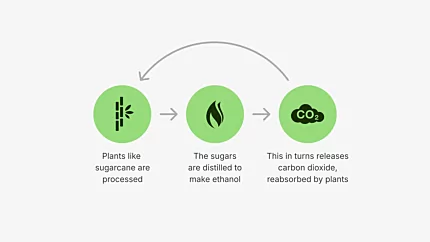
The renewability case rests on the feedstock being a plant that absorbed CO2 during growth and releases it back during combustion, so the carbon picture closes its loop. None of that means bioethanol is emission-free, the lifecycle still carries supply chain costs and the fuel itself still produces CO2, but as a side-by-side comparison the order is clear: wood produces the most concerning emissions, gas is meaningfully cleaner, and bioethanol from renewable feedstock is the cleanest of the three.
Loading image...

This is the part of the article where most comparisons declare a winner. We're not going to, because the right answer is genuinely a function of where the fire lives, who uses it, and what you're trying to create.
If your patio is open, the aesthetic brief leans modern, and gas is already plumbed nearby (or LP is acceptable), a gas fire pit or fire table is the right answer. Output is high, ignition is instant, mess is zero, and the flame holds its shape regardless of how long the evening runs. Models like the Base 40, Manhattan 50, Wharf 65, and Gin 90 cover the spectrum from compact chat-height to bar-height entertainer, and the top 10 benefits of choosing a gas fire pit article runs through the case in more detail.
If your patio is covered, your brief calls for mixed indoor and outdoor use, or you simply want a fire you can move from terrace to lounge depending on the evening, a bioethanol fire pit is the right answer. The certification path is the only one of the three that legally supports indoor use, the flame is clean enough to sit under a pergola, and the form-factor range covers everything from a tabletop centrepiece to a freestanding sculptural piece.
If budget is the primary constraint, your yard is large enough for an ember zone, and you genuinely want the smoke-and-crackle authenticity of an open fire, wood is still the right answer. It is the cheapest entry point, it gives you fuel autonomy nothing else matches, and for a specific kind of evening the smell of woodsmoke is the experience.
If you're specifying into a hospitality or architectural project, the multi-fuel Pod 30 is the single most flexible piece in the range: the same body runs on bioethanol, LP, or NG, which means you can settle the design decision now and the fuel decision once the building services pattern is clear. For covered or indoor venues, the sculptural ethanol pieces in our range give you architectural presence without a gas riser.
A note for Australian readers: our gas fire pits are not currently sold in the Australian market. If you've been drawn to a particular gas table form factor, the equivalent ethanol-fuelled piece in the same design language is the right substitution, and the experience trade-offs are smaller than the spec sheet might suggest.
Gas, wood, and bioethanol each have a coherent case, and the comparison-article instinct to declare a winner mostly tells you which one the writer happened to test last.
The decision that actually matters is the one you started with: what kind of evening do you want? If it's friends arriving for a long dinner on an open terrace, the answer leans gas. If it's a quiet hour with a glass of wine somewhere a gas line will never reach, the answer leans bioethanol. If it's a weekend gathering around something that smells like every memory of a fire you've ever had, the answer leans wood. Pick the evening first, and the fuel sorts itself out. If you'd like a quick gas-specific summary, the are gas fire pits better than wood FAQ covers the verdict in a paragraph for skim readers.